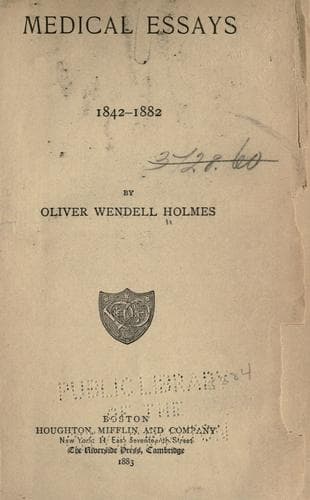
Education, Medical -- Massachusetts -- 19th century; Homeopathy; Libraries, Medical -- Massachusetts -- 19th century; Medicine
To the student I would say, that however plain and simple may be our
teaching, he must expect to forget much which he follows intelligently
in the lecture-room. But it is not the same as if he had never learned
it. A man must get a thing before he can forget it. There is a great
world of ideas we cannot voluntarily recall,--they are outside the
limits of the will. But they sway our conscious thought as the unseen
planets influence the movements of those within the sphere of vision. No
man knows how much he knows,--how many ideas he has,--any more than
he knows how many blood-globules roll in his veins. Sometimes accident
brings back here and there one, but the mind is full of irrevocable
remembrances and unthinkable thoughts, which take a part in all
its judgments as indestructible forces. Some of you must feel your
scientific deficiencies painfully after your best efforts. But every one
can acquire what is most essential. A man of very moderate ability may
be a good physician, if he devotes himself faithfully to the work. More
than this, a positively dull man, in the ordinary acceptation of the
term, sometimes makes a safer practitioner than one who has, we will
say, five per cent. more brains than his average neighbor, but who
thinks it is fifty per cent. more. Skulls belonging to this last variety
of the human race are more common, I may remark, than specimens like the
Neanderthal cranium, a cast of which you will find on the table in the
Museum.
Whether the average talent be high or low, the Colleges of the land must
make the best commodity they can out of such material as the country and
the cities furnish them. The community must have Doctors as it must
have bread. It uses up its Doctors just as it wears out its shoes, and
requires new ones. All the bread need not be French rolls, all the shoes
need not be patent leather ones; but the bread must be something that
can be eaten, and the shoes must be something that can be worn. Life
must somehow find food for the two forces that rub everything to
pieces, or burn it to ashes,--friction and oxygen. Doctors are oxydable
products, and the schools must keep furnishing new ones as the old
ones turn into oxyds; some of first-rate quality that burn with a great
light, some of a lower grade of brilliancy, some honestly, unmistakably,
by the grace of God, of moderate gifts, or in simpler phrase, dull.
Public-domain text, read in full here on John Shaqi.
Reviews
Reviews
No reviews yet
Be the first to share your thoughts on this work.
Elsewhere in the archive
Join the Discussion
Join the discussion
Sign in to leave a comment or review.
Sign InorCreate an account