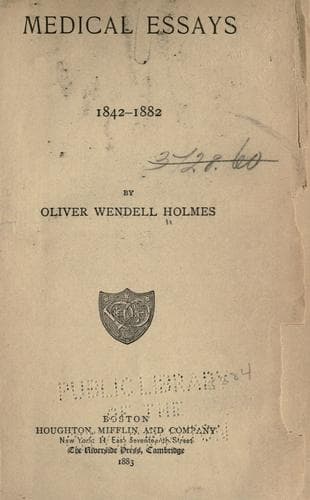
Education, Medical -- Massachusetts -- 19th century; Homeopathy; Libraries, Medical -- Massachusetts -- 19th century; Medicine
“When I first went to live with Dr. Holyoke,” he says, “in 1797, showing
me his shop, he said, 'There seems to you to be a great variety of
medicines here, and that it will take you long to get acquainted with
them, but most of them are unimportant. There are four which are equal
to all the rest, namely, Mercury, Antimony, Bark and Opium.'” And Dr.
Jackson adds, “I can only say of his practice, the longer I have lived,
I have thought better and better of it.” When he thought it necessary to
give medicine, he gave it in earnest. He hated half-practice--giving
a little of this or that, so as to be able to say that one had done
something, in case a consultation was held, or a still more ominous
event occurred. He would give opium, for instance, as boldly as the late
Dr. Fisher of Beverly, but he followed the aphorism of the Father of
Medicine, and kept extreme remedies for extreme cases.
When it came to the “non-naturals,” as he would sometimes call them,
after the old physicians,--namely, air, meat and drink, sleep and
watching, motion and rest, the retentions and excretions, and the
affections of the mind,--he was, as I have said, of the school of
sensible practitioners, in distinction from that vast community of
quacks, with or without the diploma, who think the chief end of man is
to support apothecaries, and are never easy until they can get every
patient upon a regular course of something nasty or noxious. Nobody
was so precise in his directions about diet, air, and exercise, as Dr.
Jackson. He had the same dislike to the a peu pres, the about so much,
about so often, about so long, which I afterwards found among the
punctilious adherents of the numerical system at La Pitie.
He used to insist on one small point with a certain philological
precision, namely, the true meaning of the word “cure.” He would have
it that to cure a patient was simply to care for him. I refer to it
as showing what his idea was of the relation of the physician to the
patient. It was indeed to care for him, as if his life were bound up
in him, to watch his incomings and outgoings, to stand guard at every
avenue that disease might enter, to leave nothing to chance; not merely
to throw a few pills and powders into one pan of the scales of Fate,
while Death the skeleton was seated in the other, but to lean with his
whole weight on the side of life, and shift the balance in its favor
if it lay in human power to do it. Such devotion as this is only to be
looked for in the man who gives himself wholly up to the business of
healing, who considers Medicine itself a Science, or if not a science,
is willing to follow it as an art,--the noblest of arts, which the gods
and demigods of ancient religions did not disdain to practise and to
teach.
Public-domain text, read in full here on John Shaqi.
Reviews
Reviews
No reviews yet
Be the first to share your thoughts on this work.
Elsewhere in the archive
Join the Discussion
Join the discussion
Sign in to leave a comment or review.
Sign InorCreate an account