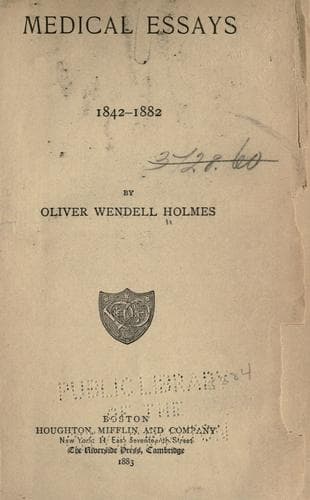
Education, Medical -- Massachusetts -- 19th century; Homeopathy; Libraries, Medical -- Massachusetts -- 19th century; Medicine
I must do violence to the modesty of the living by referring to the many
important contributions to medical science by Dr. Jacob Bigelow, and
especially to his discourse on “Self-limited Diseases,” an address which
can be read in a single hour, but the influence of which will be felt
for a century.
Nor would the profession forgive me if I forgot to mention the admirable
museum of pathological anatomy, created almost entirely by the hands
of Dr. John Barnard Swett Jackson, and illustrated by his own printed
descriptive catalogue, justly spoken of by a distinguished professor in
the University of Pennsylvania as the most important contribution which
had ever been made in this country to the branch to which it relates.
When we look at the literature of mental disease, as seen in hospital
reports and special treatises, we can mention the names of Wyman,
Woodward, Brigham, Bell, and Ray, all either natives of Massachusetts or
placed at the head of her institutions for the treatment of the insane.
We have a right to claim also one who is known all over the civilized
world as a philanthropist, to us as a townsman and a graduate of our own
Medical School, Dr. Samuel Gridley Howe, the guide and benefactor of
a great multitude who were born to a world of inward or of outward
darkness.
I cannot pass over in silence the part taken by our own physicians
in those sanitary movements which are assuming every year greater
importance. Two diseases especially have attracted attention, above
all others, with reference to their causes and prevention; cholera,
the “black death” of the nineteenth century, and consumption, the white
plague of the North, both of which have been faithfully studied and
reported on by physicians of our own State and city. The cultivation of
medical and surgical specialties, which is fast becoming prevalent, is
beginning to show its effects in the literature of the profession,
which is every year growing richer in original observations and
investigations.
To these benefactors who have labored for us in their peaceful vocation,
we must add the noble army of surgeons, who went with the soldiers who
fought the battles of their country, sharing many of their dangers, not
rarely falling victims to fatigue, disease, or the deadly volleys to
which they often exposed themselves in the discharge of their duties.
Public-domain text, read in full here on John Shaqi.
Reviews
Reviews
No reviews yet
Be the first to share your thoughts on this work.
Elsewhere in the archive
Join the Discussion
Join the discussion
Sign in to leave a comment or review.
Sign InorCreate an account