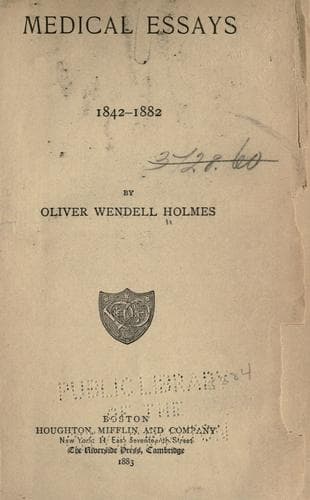
Education, Medical -- Massachusetts -- 19th century; Homeopathy; Libraries, Medical -- Massachusetts -- 19th century; Medicine
A certain amount of natural ability is requisite to make you a good
physician, but by no means that disproportionate development of some
special faculty which goes by the name of genius. A just balance of the
mental powers is a great deal more likely to be useful than any single
talent, even were it the power of observation, in excess. For a mere
observer is liable to be too fond of facts for their own sake, so that,
if he told the real truth, he would confess that he takes more pleasure
in a post-mortem examination which shows him what was the matter with a
patient, than in a case which insists on getting well and leaving him in
the dark as to its nature. Far more likely to interfere with the sound
practical balance of the mind is that speculative, theoretical tendency
which has made so many men noted in their day, whose fame has passed
away with their dissolving theories. Read Dr. Bartlett's comparison of
the famous Benjamin Rush with his modest fellow-townsman Dr. William
Currie, and see the dangers into which a passion for grandiose
generalizations betrayed a man of many admirable qualities.
I warn you against all ambitious aspirations outside of your profession.
Medicine is the most difficult of sciences and the most laborious of
arts. It will task all your powers of body and mind if you are faithful
to it. Do not dabble in the muddy sewer of politics, nor linger by
the enchanted streams of literature, nor dig in far-off fields for the
hidden waters of alien sciences. The great practitioners are generally
those who concentrate all their powers on their business. If there
are here and there brilliant exceptions, it is only in virtue of
extraordinary gifts, and industry to which very few are equal.
To get business a man must really want it; and do you suppose that when
you are in the middle of a heated caucus, or half-way through a delicate
analysis, or in the spasm of an unfinished ode, your eyes rolling in the
fine frenzy of poetical composition, you want to be called to a teething
infant, or an ancient person groaning under the griefs of a lumbago?
I think I have known more than one young man whose doctor's sign
proclaimed his readiness to serve mankind in that capacity, but who
hated the sound of a patient's knock, and as he sat with his book or his
microscope, felt exactly as the old party expressed himself in my friend
Mr. Brownell's poem--
“All I axes is, let me alone.”
The community soon finds out whether you are in earnest, and really mean
business, or whether you are one of those diplomaed dilettanti who like
the amusement of quasi medical studies, but have no idea of wasting
their precious time in putting their knowledge in practice for the
benefit of their suffering fellow-creatures.
Public-domain text, read in full here on John Shaqi.
Reviews
Reviews
No reviews yet
Be the first to share your thoughts on this work.
Elsewhere in the archive
Join the Discussion
Join the discussion
Sign in to leave a comment or review.
Sign InorCreate an account