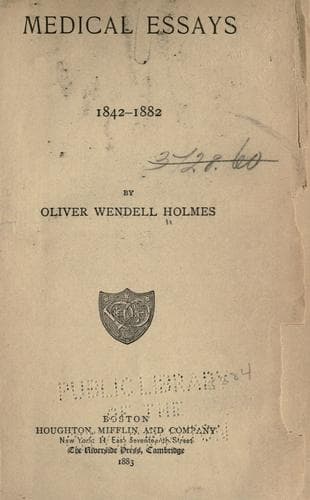
Education, Medical -- Massachusetts -- 19th century; Homeopathy; Libraries, Medical -- Massachusetts -- 19th century; Medicine
If you cannot acquire and keep the confidence of your patient, it is
time for you to give place to some other practitioner who can. If you
are wise and diligent, you can establish relations with the best of them
which they will find it very hard to break. But, if they wish to employ
another person, who, as they think, knows more than you do, do not take
it as a personal wrong. A patient believes another man can save his
life, can restore him to health, which, as he thinks, you have not the
skill to do. No matter whether the patient is right or wrong, it is a
great impertinence to think you have any property in him. Your estimate
of your own ability is not the question, it is what the patient thinks
of it. All your wisdom is to him like the lady's virtue in Raleigh's
song:
“If she seem not chaste to me,
What care I how chaste she be?”
What I call a good patient is one who, having found a good physician,
sticks to him till he dies. But there are many very good people who are
not what I call good patients. I was once requested to call on a
lady suffering from nervous and other symptoms. It came out in the
preliminary conversational skirmish, half medical, half social, that
I was the twenty-sixth member of the faculty into whose arms,
professionally speaking, she had successively thrown herself. Not
being a believer in such a rapid rotation of scientific crops, I gently
deposited the burden, commending it to the care of number twenty-seven,
and, him, whoever he might be, to the care of Heaven.
If there happened to be among my audience any person who wished to know
on what principles the patient should choose his physician, I should
give him these few precepts to think over:
Choose a man who is personally agreeable, for a daily visit from an
intelligent, amiable, pleasant, sympathetic person will cost you no more
than one from a sloven or a boor, and his presence will do more for you
than any prescription the other will order.
Let him be a man of recognized good sense in other matters, and the
chance is that he will be sensible as a practitioner.
Let him be a man who stands well with his professional brethren, whom
they approve as honest, able, courteous.
Let him be one whose patients are willing to die in his hands, not one
whom they go to for trifles, and leave as soon as they are in danger,
and who can say, therefore, that he never loses a patient.
Public-domain text, read in full here on John Shaqi.
Reviews
Reviews
No reviews yet
Be the first to share your thoughts on this work.
Elsewhere in the archive
Join the Discussion
Join the discussion
Sign in to leave a comment or review.
Sign InorCreate an account