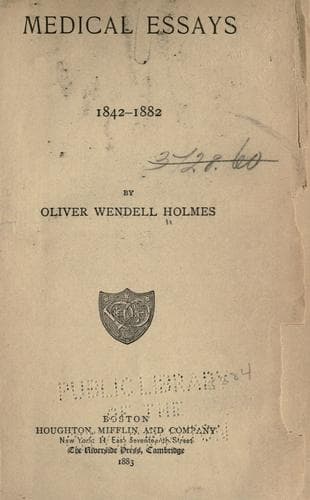
Education, Medical -- Massachusetts -- 19th century; Homeopathy; Libraries, Medical -- Massachusetts -- 19th century; Medicine
Nothing, therefore, could be more pleasing to me than to see the
attention which has been given of late years to the great work of
indexing. It is a quarter of a century since Mr. Poole published his
“Index to Periodical Literature,” which it is much to be hoped is soon
to appear in a new edition, grown as it must be to formidable dimensions
by the additions of so long a period. The “British and Foreign Medical
Review,” edited by the late Sir John Forties, contributed to by Huxley,
Carpenter, Laycock, and others of the most distinguished scientific men
of Great Britain, has an index to its twenty-four volumes, and by its
aid I find this valuable series as manageable as a lexicon. The last
edition of the “Encyclopaedia Britannica” had a complete index in a
separate volume, and the publishers of Appletons' “American Cyclopaedia”
have recently issued an index to their useful work, which must greatly
add to its value. I have already referred to the index to the “North
American Review,” which to an American, and especially to a New
Englander, is the most interesting and most valuable addition of its
kind to our literary apparatus since the publication of Mr. Allibone's
“Dictionary of Authors.” I might almost dare to parody Mr. Webster's
words in speaking of Hamilton, to describe what Mr. Gushing did for the
solemn rows of back volumes of our honored old Review which had been
long fossilizing on our shelves: “He touched the dead corpse of the
'North American,' and it sprang to its feet.” A library of the best
thought of the best American scholars during the greater portion of the
century was brought to light by the work of the indexmaker as truly as
were the Assyrian tablets by the labors of Layard.
A great portion of the best writing and reading--literary, scientific,
professional, miscellaneous--comes to us now, at stated intervals, in
paper covers. The writer appears, as it were, in his shirt-sleeves. As
soon as he has delivered his message the book-binder puts a coat on
his back, and he joins the forlorn brotherhood of “back volumes,” than
which, so long as they are unindexed, nothing can be more exasperating.
Who wants a lock without a key, a ship without a rudder, a binnacle
without a compass, a check without a signature, a greenback without a
goldback behind it?
I have referred chiefly to the medical journals, but I would include
with these the reports of medical associations, and those separate
publications which, coming in the form of pamphlets, heap themselves
into chaotic piles and bundles which are worse than useless, taking up a
great deal of room, and frightening everything away but mice and mousing
antiquarians, or possibly at long intervals some terebrating specialist.
Public-domain text, read in full here on John Shaqi.
Reviews
Reviews
No reviews yet
Be the first to share your thoughts on this work.
Elsewhere in the archive
Join the Discussion
Join the discussion
Sign in to leave a comment or review.
Sign InorCreate an account