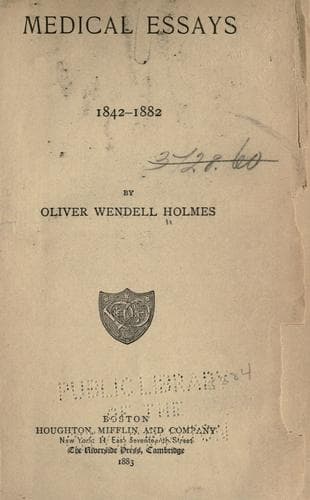
Education, Medical -- Massachusetts -- 19th century; Homeopathy; Libraries, Medical -- Massachusetts -- 19th century; Medicine
A library like ours must exercise the largest hospitality. A great many
books may be found in every large collection which remind us of those
apostolic looking old men who figure on the platform at our political
and other assemblages. Some of them have spoken words of wisdom in their
day, but they have ceased to be oracles; some of them never had any
particularly important message for humanity, but they add dignity to the
meeting by their presence; they look wise, whether they are so or not,
and no one grudges them their places of honor. Venerable figure-heads,
what would our platforms be without you?
Just so with our libraries. Without their rows of folios in creamy
vellum, or showing their black backs with antique lettering of tarnished
gold, our shelves would look as insufficient and unbalanced as a column
without its base, as a statue without its pedestal. And do not think
they are kept only to be spanked and dusted during that dreadful period
when their owner is but too thankful to become an exile and a wanderer
from the scene of single combats between dead authors and living
housemaids. Men were not all cowards before Agamemnon or all fools
before the days of Virchow and Billroth. And apart from any practical
use to be derived from the older medical authors, is there not a true
pleasure in reading the accounts of great discoverers in their own
words? I do not pretend to hoist up the Bibliotheca Anatomica of
Mangetus and spread it on my table every day. I do not get out my great
Albinus before every lecture on the muscles, nor disturb the majestic
repose of Vesalius every time I speak of the bones he has so admirably
described and figured. But it does please me to read the first
descriptions of parts to which the names of their discoverers or those
who have first described them have become so joined that not even modern
science can part them; to listen to the talk of my old volume as Willis
describes his circle and Fallopius his aqueduct and Varolius his bridge
and Eustachius his tube and Monro his foramen,--all so well known to
us in the human body; it does please me to know the very words in which
Winslow described the opening which bears his name, and Glisson his
capsule and De Graaf his vesicle; I am not content until I know in what
language Harvey announced his discovery of the circulation, and how
Spigelius made the liver his perpetual memorial, and Malpighi found a
monument more enduring than brass in the corpuscles of the spleen and
the kidney.
But after all, the readers who care most for the early records of
medical science and art are the specialists who are dividing up the
practice of medicine and surgery as they were parcelled out, according
to Herodotus, by the Egyptians. For them nothing is too old, nothing is
too new, for to their books of all others is applicable the saying of
D'Alembert that the author kills himself in lengthening out what the
reader kills himself in trying to shorten.
Public-domain text, read in full here on John Shaqi.
Reviews
Reviews
No reviews yet
Be the first to share your thoughts on this work.
Elsewhere in the archive
Join the Discussion
Join the discussion
Sign in to leave a comment or review.
Sign InorCreate an account