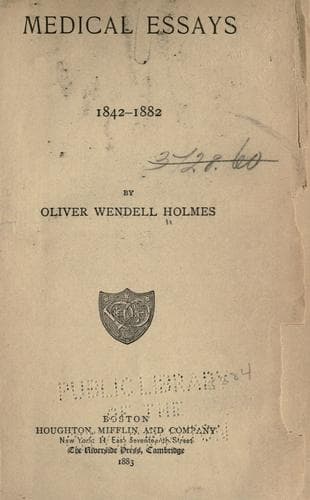
Education, Medical -- Massachusetts -- 19th century; Homeopathy; Libraries, Medical -- Massachusetts -- 19th century; Medicine
He belongs to a class of minds which we are bound to be
patient with if their Maker sees fit to indulge them with existence. We
must accept the conjuring ultra-ritualist, the dreamy second adventist,
the erratic spiritualist, the fantastic homoeopathist, as not unworthy
of philosophic study; not more unworthy of it than the squarers of the
circle and the inventors of perpetual motion, and the other whimsical
visionaries to whom De Morgan has devoted his most instructive and
entertaining “Budget of Paradoxes.” I hope, therefore, that our library
will admit the works of the so-called Eclectics, of the Thomsonians, if
any are in existence, of the Clairvoyants, if they have a literature,
and especially of the Homoeopathists. This country seems to be the place
for such a collection, which will by and by be curious and of more value
than at present, for Homoeopathy seems to be following the pathological
law of erysipelas, fading out where it originated as it spreads to new
regions. At least I judge so by the following translated extract from
a criticism of an American work in the “Homoeopatische Rundschau” of
Leipzig for October, 1878, which I find in the “Homoeopathic Bulletin”
for the month of November just passed: “While we feel proud of
the spread and rise of Homoeopathy across the ocean, and while the
Homoeopathic works reaching us from there, and published in a style
such as is unknown in Germany, bear eloquent testimony to the eminent
activity of our transatlantic colleagues, we are overcome by sorrowful
regrets at the position Homoeopathy occupies in Germany. Such a work [as
the American one referred to] with us would be impossible; it would lack
the necessary support.”
By all means let our library secure a good representation of the
literature of Homoeopathy before it leaves us its “sorrowful regrets”
and migrates with its sugar of milk pellets, which have taken the place
of the old pilulae micae panis, to Alaska, to “Nova Zembla, or the Lord
knows where.”
What shall I say in this presence of the duties of a Librarian? Where
have they ever been better performed than in our own public city
library, where the late Mr. Jewett and the living Mr. Winsor have shown
us what a librarian ought to be,--the organizing head, the vigilant
guardian, the seeker's index, the scholar's counsellor? His work is not
merely that of administration, manifold and laborious as its duties are.
He must have a quick intelligence and a retentive memory. He is a
public carrier of knowledge in its germs. His office is like that which
naturalists attribute to the bumble-bee,--he lays up little honey for
himself, but he conveys the fertilizing pollen from flower to flower.
Public-domain text, read in full here on John Shaqi.
Reviews
Reviews
No reviews yet
Be the first to share your thoughts on this work.
Elsewhere in the archive
Join the Discussion
Join the discussion
Sign in to leave a comment or review.
Sign InorCreate an account