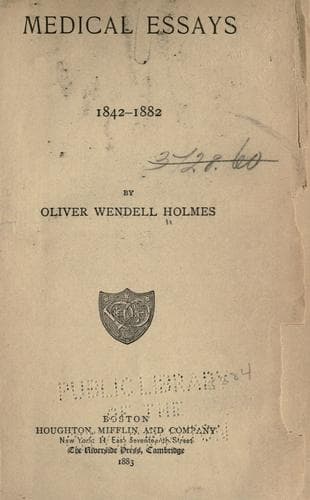
Education, Medical -- Massachusetts -- 19th century; Homeopathy; Libraries, Medical -- Massachusetts -- 19th century; Medicine
A physiological laboratory of to-day is equipped with instruments of
research of such ingenious contrivance, such elaborate construction,
that one might suppose himself in a workshop where some exquisite fabric
was to be wrought, such as Queens love to wear, and Kings do not always
love to pay for. They are, indeed, weaving a charmed web, for these are
the looms from which comes the knowledge that clothes the nakedness of
the intellect. Here are the mills that grind food for its hunger, and
“is not the life more than meat, and the body than raiment?”
But while many of the sciences have so changed that the teachers of the
past would hardly know them, it has not been so with the branch I teach,
or, rather, with that division of it which is chiefly taught in this
amphitheatre. General anatomy, or histology, on the other hand, is
almost all new; it has grown up, mainly, since I began my medical
studies. I never saw a compound microscope during my years of study in
Paris. Individuals had begun to use the instrument, but I never heard
it alluded to by either Professors or students. In descriptive anatomy I
have found little to unlearn, and not a great deal that was both new and
important to learn. Trifling additions are made from year to year, not
to be despised and not to be overvalued. Some of the older anatomical
works are still admirable, some of the newer ones very much the
contrary. I have had recent anatomical plates brought me for inspection,
and I have actually button-holed the book-agent, a being commonly as
hard to get rid of as the tar-baby in the negro legend, that I might put
him to shame with the imperial illustrations of the bones and muscles
in the great folio of Albinus, published in 1747, and the unapproached
figures of the lymphatic system of Mascagni, now within a very few years
of a century old, and still copied, or, rather, pretended to be copied,
in the most recent works on anatomy.
I am afraid that it is a good plan to get rid of old Professors, and I
am thankful to hear that there is a movement for making provision
for those who are left in need when they lose their offices and their
salaries. I remember one of our ancient Cambridge Doctors once asked me
to get into his rickety chaise, and said to me, half humorously, half
sadly, that he was like an old horse,--they had taken off his saddle and
turned him out to pasture. I fear the grass was pretty short where that
old servant of the public found himself grazing. If I myself needed an
apology for holding my office so long, I should find it in the fact that
human anatomy is much the same study that it was in the days of Vesalius
and Fallopius, and that the greater part of my teaching was of such a
nature that it could never become antiquated.
Public-domain text, read in full here on John Shaqi.
Reviews
Reviews
No reviews yet
Be the first to share your thoughts on this work.
Elsewhere in the archive
Join the Discussion
Join the discussion
Sign in to leave a comment or review.
Sign InorCreate an account