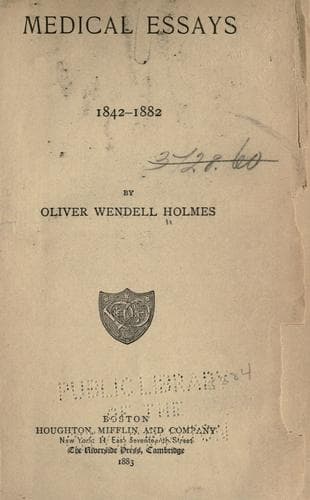
Education, Medical -- Massachusetts -- 19th century; Homeopathy; Libraries, Medical -- Massachusetts -- 19th century; Medicine
XII. Until it is proved to what removable condition attaching to the
attendant the disease is owing, he is bound to stay away from his
patients so soon as he finds himself singled out to be tracked by the
disease. How long, and with what other precautions, I have suggested,
without dictating, at the close of my Essay. If the physician does
not at once act on any reasonable suspicion of his being the medium of
transfer, the families where he is engaged, if they are allowed to know
the facts, should decline his services for the time. His feelings on the
occasion, however interesting to himself, should not be even named in
this connection. A physician who talks about ceremony and gratitude, and
services rendered, and the treatment he got, surely forgets himself;
it is impossible that he should seriously think of these small matters
where there is even a question whether he may not carry disease, and
death, and bereavement into any one of “his families,” as they are
sometimes called.
I will now point out to the young student the mode in which he may
relieve his mind of any confusion, or possibly, if very young, any
doubt, which the perusal of Dr. Meigs's Sixth Letter may have raised in
his mind.
The most prominent ideas of the Letter are, first, that the
transmissible nature of puerperal fever appears improbable, and,
secondly, that it would be very inconvenient to the writer. Dr.
Woodville, Physician to the Small-Pox and Inoculation Hospital in
London, found it improbable, and exceedingly inconvenient to himself,
that cow pox should prevent small-pox; but Dr. Jenner took the liberty
to prove the fact, notwithstanding.
Public-domain text, read in full here on John Shaqi.
Reviews
Reviews
No reviews yet
Be the first to share your thoughts on this work.
Elsewhere in the archive
Join the Discussion
Join the discussion
Sign in to leave a comment or review.
Sign InorCreate an account