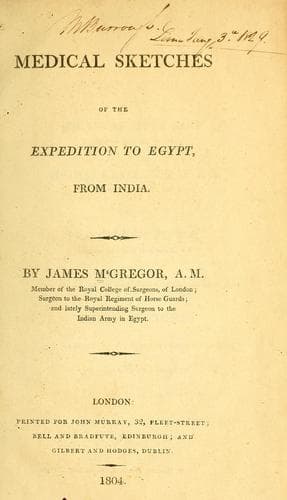
Medical Sketches of the Expedition to Egypt, from IndiaMcGrigor, James, Sir
History
Medical Sketches of the Expedition to Egypt, from India
McGrigor, James, Sir
Great Britain. Army -- Sanitary affairs; Medicine, Military
The plague made its first appearance, in the army from India, in the
middle of September, 1801. From its early appearance the natives were
very much alarmed, and prophesied a dreadful season of plague. They have
observed, that, when it breaks out before December, they have always a
generally-prevailing and a very destructive disease.
The number of cases which appeared in the Indian army, from the 15th of
September, 1801, to the 15th of June, 1802, is seen in an accompanying
table.
After the plague broke out, the disease was for a long time confined to
Rosetta; it was otherwise in the former season.
Soon after the British army effected their landing at Aboukir, in March,
1801, they were attacked with the plague, though the season was then on
the decline. In the beginning of the year, the disease had prevailed very
generally over the whole country, and the loss arising from thence, to
the French, was considerable. It continued to spread in the British army
till May, during which month few cases appeared; but none I believe in
June.
Though the contagion is seldom or never, I believe, out of the country,
the natives of Egypt denominate the season of plague from November or
December of one year, to June of the year following; they observe, that
the disease constantly stops at the period of the summer solstice.
I have said, that, during the season ending in June, 1801, the disease
prevailed very generally in Egypt; Rosetta, however, was an exception; if
any case did occur there it was concealed.
At Cairo, Alexandria, and Damietta; at Suez, in the villages, and in
Upper Egypt; it proved very fatal: at Siout, at Girgé, and in general
throughout the towns and villages in Upper Egypt, we saw continued marks
of its desolation, and heard many dismal accounts of its ravages.
The reason of the plague first appearing in, and afterwards being
confined only to, Rosetta, in the last season, was, that it was the only
open port to which vessels from Turkey and Greece resorted; and that from
some of these, no doubt, the disease was imported.
In the pest-houses of the army, thirteen medical gentlemen did duty,
who in the Indian army might be said to have had the post of honour.
They were, Mr Thomas, Mr Price, Mr Rice, Dr Whyte, Mr Grysadale, Mr
Adrian, Mr O’Farrel, Mr Whyte, Mr Dyson, Mr Angle, Mr Moss, Dr Buchan,[4]
and Dr Henderson. Besides these, Mr Cloran was in charge of the cases
under observation, and Mr Bell of cases under quarantine. Mr Blackwell,
surgeon on the staff of the English army, acted as inspecting surgeon
to the Board of Health. He visited every case in the first instance,
and, as he judged it necessary, sent them to the quarantine, to the
observation-ground, or to the pest-house: to Mr Blackwell’s unceasing
attention and discriminating knowledge of the pestilential symptoms, we
owed no small share of our safety in Alexandria.
Public-domain text, read in full here on John Shaqi.
Reviews
Reviews
No reviews yet
Be the first to share your thoughts on this work.
Join the Discussion
Join the discussion
Sign in to leave a comment or review.
Sign InorCreate an account