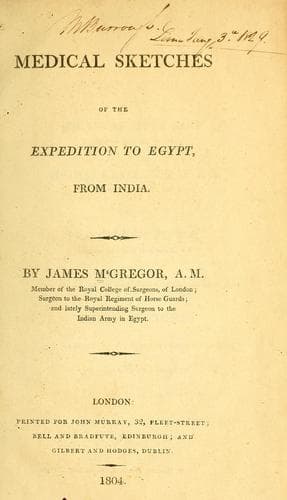
Medical Sketches of the Expedition to Egypt, from IndiaMcGrigor, James, Sir
History
Medical Sketches of the Expedition to Egypt, from India
McGrigor, James, Sir
Great Britain. Army -- Sanitary affairs; Medicine, Military
In subsequent letters, Mr Rice says, “that Dr Whyte continued in good
health on the 5th, and all day on the 6th, till the evening, when he was
attacked with rigors and other febrile symptoms. He said himself that
it was the attack of an intermittent; and it bore a great resemblance
to it. After sweating profusely, he was better in the morning of the
7th, but in the afternoon the shivering returned; and, after it had
continued 30 minutes, a severe hot stage came on, then a profuse sweating
followed, but with it much affection of the head, tremor of the limbs,
particularly of the upper extremities, tongue black and dry, skin hot,
pulse full, hard, and irregular, thirst great, prostration of strength,
and anxiety. The head was the only place that he complained of, and it
seemed to be the principal seat of his disease; he still persisted that
the disease was not the plague; he would not allow his groin or arm-pits
to be examined, and he refused all medical assistance.” He asked for a
purgative, which Mr Rice gave him, and he requested to be bled, this Mr
Rice thought the state of the symptoms would not justify him in doing. On
the 8th, these symptoms continued, and there was some delirium; he begged
to be removed from the pest-house at El Hammed, to the old pest-house at
Rosetta, under the charge of Arabs. He was removed on the morning of the
9th, and died in the afternoon of that day very delirious.
2d, Mr Price did duty in the pest-house at Rosetta and at El Hammed from
the beginning of November, 1801, and had a tertian which he never could
completely remove. In the pest-house at El Hammed, he was in the evening
of the 1st of January attacked with rigors and slight febrile symptoms;
but he himself thought this was only an attack of his intermittent, he
soon however felt an affection of his head, and tremor of his limbs,
and knew his disease. On the morning of the 2d, three buboes appeared,
two femoral and one axillary; he then became delirious, and had no
recollection of any thing for several days. On the 5th, there was a
remission of the fever. He was able, on the 7th, to write me, “that he
had no fever, that one bubo was coming on, and that he was extremely
debilitated.” On the 13th Mr Rice opened his bubo; but it was two months
after this before he recovered.
I am sorry I cannot find a letter where the treatment of Mr Price is
detailed; but I am pretty clear that it was by mercury, as this was his
own practice at the time.
Public-domain text, read in full here on John Shaqi.
Reviews
Reviews
No reviews yet
Be the first to share your thoughts on this work.
Elsewhere in the archive
Join the Discussion
Join the discussion
Sign in to leave a comment or review.
Sign InorCreate an account