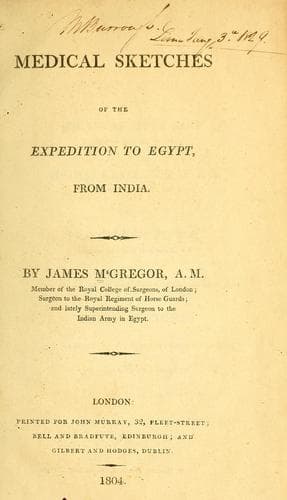
Medical Sketches of the Expedition to Egypt, from IndiaMcGrigor, James, Sir
History
Medical Sketches of the Expedition to Egypt, from India
McGrigor, James, Sir
Great Britain. Army -- Sanitary affairs; Medicine, Military
It would appear, that, in different countries and in different seasons
in the same countries, the plague assumes very different appearances.
The plague is seen as varied in its appearance as the different fevers
described by Sydenham to prevail in different years, and under different
constitutions of the air, in England.
Our knowledge of this fact enables us to reconcile the different or
opposite accounts given of the disease, and of its treatment by different
writers.
In the Indian army, when the disease first broke out, the cases sent
from the crowded hospitals of the 61st and 88th regiments, were from the
commencement attended with the typhoid or low symptoms.
The cases sent from the Bengal volunteer battalion, and from the other
corps, when the army was encamped near the marshy ground at El Hammed,
were all of the intermittent or remittent type.
The cases which occurred, in the cold rainy months of December and
January, had much of the inflammatory diathesis. Mr A. Whyte remarked,
that every case admitted into the hospital, at Rahamania, had the
symptoms of pneumonia.
In the end of the season, at Cairo, Ghiza, Boulac, and on crossing the
isthmus of Suez, the disease wore the form of a mild continued fever.
The resemblance which some cases shewn and of others described to me bore
to the West-Indian fever struck me very forcibly.
I know not that I can better describe the disease, than by a short
statement of the cases of some of the medical gentlemen who had the
disease; most of whom wrote me accurately every thing that they felt. Dr
Whyte entered the pest-house at El Hammed on the evening of the 2d of
January, 1802. In a letter of that date he writes to me, “I just now
inoculated myself, by friction, with bubonic matter on the left thigh;”
on the 3d, he says, “I have this morning inoculated myself by incision
on the right fore-arm.” Mr Rice, then doing duty in the pest-house at El
Hammed, gives the whole of the case. In a letter on the 3d of January, he
writes to me, “Dr Whyte came here last night; soon after he came in, he
rubbed some matter from the bubo of a woman on the inside of his thighs.
The next morning, he inoculated himself in the wrist with a lancet, with
matter taken from the running bubo of a Sepoy; he appears now very well.”
Public-domain text, read in full here on John Shaqi.
Reviews
Reviews
No reviews yet
Be the first to share your thoughts on this work.
Elsewhere in the archive
Join the Discussion
Join the discussion
Sign in to leave a comment or review.
Sign InorCreate an account