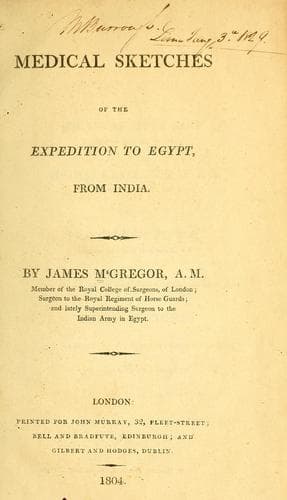
Medical Sketches of the Expedition to Egypt, from IndiaMcGrigor, James, Sir
History
Medical Sketches of the Expedition to Egypt, from India
McGrigor, James, Sir
Great Britain. Army -- Sanitary affairs; Medicine, Military
I received several accounts of the good effects of mercury from the
gentlemen in the pest-houses, but none so remarkable as the following:—In
the beginning of the season, on the breaking out of the disease in the
crowded hospital of the 88th regiment; every man in the hospital was
examined at different periods of the day, and thus the disease was
detected on its very first appearance. At this time, I gave to each of
three of the men, placed in the observation-ward of the hospital, (of
whom Littlejohn and Egan have already been mentioned,) two grains of
calomel, and the sixth of a grain of opium every hour, and made them
rub into the inside of the legs, thighs, arms, and neck, half an ounce
of the strong mercurial ointment three times a day. I, at the same time,
made them take each half an ounce of nitric acid diluted in their drink
during the day, and put their feet and hands, three times during the
day, into a strong nitric bath. In about twenty-four hours, their mouths
became severely affected, a tenderness in their arm-pits and groins went
off, and the severest febrile symptoms yielded. The men were, however,
extremely debilitated, and remained a very long time convalescent. During
their convalescence, I thought it prudent to keep them in quarantine,
being fully convinced, that they had had an attack of the plague, the
progress of which had been arrested, and the disease cut short by the
above treatment.
Corporal Francis, as already mentioned, was suddenly attacked with
giddiness after coming off from duty as corporal of the guard in the
pest-house. In the very commencement of the disease, on the first feeling
of illness, he was brought to Mr Price, who instantly admitted him and
immediately exhibited mercury, and as soon as the gums became affected,
the febrile symptoms vanished. He remained some time in the hospital, on
account of a bubo, which came to suppuration; but Francis suffered very
little. He was never more than two days confined to bed, though the case
occurred at a time when the disease was very violent.
The case of Peter the interpreter strongly evinces the success of the
mercurial treatment. To this case, the mercurial pills and ointment were
given; and he was, in every respect, treated as a case of syphilis and
was speedily cured.
In the cases related, there appeared some facts as to the time the
matter of the pestilential contagion takes before it comes into action.
Other facts shew, that, in different people, and under different
circumstances, there is the greatest variety in this. The lazaretto at
Alexandria was infected by the admission of an Italian merchant, and the
guard there, consisting of 14 men, caught the disease, but were attacked
on different days. The provost’s guard and his prisoners at Alexandria
caught the infection from a deserter confined among them, and the disease
among these people appeared at very different periods.
Public-domain text, read in full here on John Shaqi.
Reviews
Reviews
No reviews yet
Be the first to share your thoughts on this work.
Elsewhere in the archive
Join the Discussion
Join the discussion
Sign in to leave a comment or review.
Sign InorCreate an account