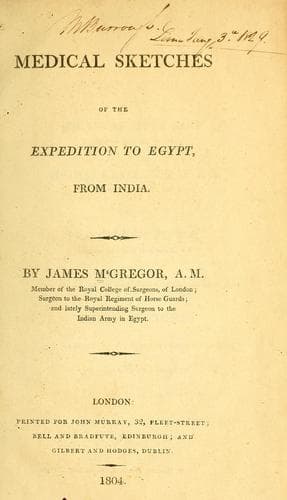
Medical Sketches of the Expedition to Egypt, from IndiaMcGrigor, James, Sir
History
Medical Sketches of the Expedition to Egypt, from India
McGrigor, James, Sir
Great Britain. Army -- Sanitary affairs; Medicine, Military
Mr Rice relates two cases on this part of the subject, which appear
worthy of detail: he says, “we have had proofs, that the pestilential
virus remains a considerable time in the habit, without exerting its
influence or shewing its virulence. A striking case occurred lately: a
Sepoy was sent to the pest-house from the hospital of the 7th regiment
with plague; his wife could not be prevented from accompanying him, where
she attended and nursed him. The Sepoy died, and the woman was ordered
into quarantine; however, she escaped, and after some days search she
was discovered near the regimental hospital of the 7th. As this woman had
the greatest reluctance to going to quarantine, a centinel was put over
her in the hut where she was, and all communication with her was stopped:
she continued in good health till the tenth day after her escape from the
pest-house; in the afternoon of this day, she was attacked with fever,
in a few hours after, the inguinal glands became painful, and she was
carried to the pest-house at El Hammed.”
“Another case bore a great affinity to the above: a Sepoy came into the
pest-house to attend his wife: the man was sent into quarantine, and he
continued well there, till the seventeenth day, on which plague-symptoms
appeared, and he was sent to the pest-house.”
Of the symptoms of the plague, fever, though not always present, seemed
the most constant.
At the end of the season, at Cairo, at Ghiza, and at Suez, cases appeared
without any observable fever. When it did appear, as already noticed,
the type at different seasons, and in different parts of Egypt, was very
various. At the pest-house at Rosetta and El Hammed, many of the cases,
admitted from October to January, had the accompanying fever intermittent
and of the quotidian type. This I believe to be a new fact in the history
of the disease. For some time in January, February, and in some part of
March, the fever had regular remissions. After this period, it generally
appeared of the typhus form at Aboukir, except in the detachment of the
26th Light Dragoons, all of whom were young healthy men, and in them Mr
O’Farrel observed, “that there was much re-action, and that the delirium
was of the kind denominated phrenitis.”
At the pest-house, at Rahaminia, Mr Whyte observed, that all his patients
had pluritic complaints.
The second symptom in order was the tremor of the limbs. Mr Price says,
“that bubo and pyrexia are not so essential parts of the diagnosis, as
tremor of the upper extremities,” and
3dly, The affection of the head, which was sometimes phrenitis, and
sometimes typhomania. In a great majority of Mr Price’s, Mr Rice’s, and
Mr Whyte’s, cases there was much nervous affection; in one, the risus
sardonicus. Mr Adrian says, the nervous affection, in many cases, was
very remarkable; in several cases, it resembled the description, given
by authors, of that nervous affection produced by the bites of mad or
poisonous animals, an almost universal tremor.
Public-domain text, read in full here on John Shaqi.
Reviews
Reviews
No reviews yet
Be the first to share your thoughts on this work.
Elsewhere in the archive
Join the Discussion
Join the discussion
Sign in to leave a comment or review.
Sign InorCreate an account