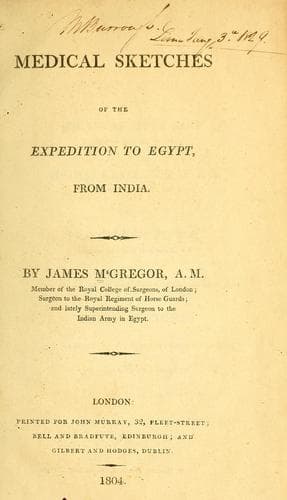
Medical Sketches of the Expedition to Egypt, from IndiaMcGrigor, James, Sir
History
Medical Sketches of the Expedition to Egypt, from India
McGrigor, James, Sir
Great Britain. Army -- Sanitary affairs; Medicine, Military
Dr Whyte used the lancet very freely, but every one of his patients died;
Dr Buchan was in the habit occasionally of having recourse to it; and,
in the first season, he said, that he had met with several cases where
bleeding was of the greatest service. In the beginning of the season, Mr
Price bled one patient. The blood appeared very dark, and dissolved: this
patient died, and Mr Price never repeated the operation on any other.
Some gentlemen, attached to the Brunonian system, put the stimulating
plan to the test. By Messieurs Adrian and Whyte, patients were for some
time kept under the influence of wine and opium; but, this practice was
never successful and they deserted it. It was at length the practice of
Mr Adrian to unite stimulants and mercurials.
Seldom before, I believe, have the bodies of those who died of this
disease been dissected. The first was a Sepoy, by Mr Price alone; the
second by Messieurs Price and Rice; and, in the last subject, viz.
Signior Posetti, the Italian merchant, so severely affected were both
of these gentlemen, that it put a stop to this mode of investigation.
The general appearances seen on the subjects, were, a perfectly-diseased
state of the glandular system. In the liver, no matter was found; but,
it was much enlarged and greatly diseased. Signior Posetti had only one
bubo; the femoral gland was sixteen times the natural size and weight;
and the blood, from the femoral artery, flowed black, pitchy, and
dissolved in its texture. I come now to the last, and most pleasing part
of the subject, the means of
_The prevention._ If, in the treatment of the disease, we were not
successful, we assuredly were completely so in the prevention. At length,
this became so generally known, that we no longer heard the distressing
accounts of despondence and despair among the natives. They now no longer
entertained such a dread of the pest-houses. We at length even found
volunteers from the natives for duty in the pest-houses.
There was hardly a corps, or an hospital in the army, where, at one
period or other, the disease did not make its appearance, but it was
always in our power to arrest its progress. In well regulated corps,
where a rigid discipline was enforced, and proper attention to the
interior economy was paid, it rarely happened, indeed, that much
difficulty was experienced in eradicating the contagion.
As our success in the prevention was so great, all that remains for me
is to mention the substance of General Baird’s order to the army on this
subject.
1st, To every hospital, an observation-room, or in lieu of it a tent was
attached, and to it, every case whatever with febrile symptoms was sent,
as soon as discovered, and was there most strictly watched by the surgeon.
Public-domain text, read in full here on John Shaqi.
Reviews
Reviews
No reviews yet
Be the first to share your thoughts on this work.
Elsewhere in the archive
Join the Discussion
Join the discussion
Sign in to leave a comment or review.
Sign InorCreate an account