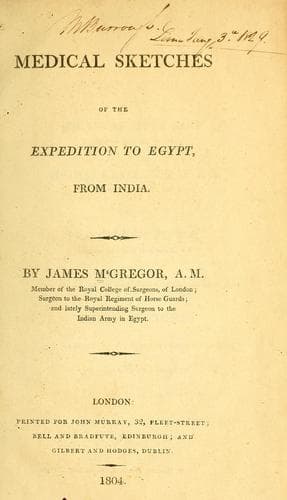
Medical Sketches of the Expedition to Egypt, from IndiaMcGrigor, James, Sir
History
Medical Sketches of the Expedition to Egypt, from India
McGrigor, James, Sir
Great Britain. Army -- Sanitary affairs; Medicine, Military
On our arrival at Point de Galle, in Ceylon, we found that the disease
was unknown in his Majesty’s 19th foot, among the Sepoys who came from
Bengal or Madras; in the Malay corps: and, as far as I could learn,
among the inhabitants. During our stay in Ceylon, a few cases made their
appearance in the 86th and 88th regiments on shore. On sailing from
this island for the Red Sea, only three hundred and sixty men, of the
88th regiment, with the artillery, were embarked in the Minerva. Two
companies of the 88th were embarked in a small vessel, the Fancy. Another
vessel, the Hope, was provided for the detachment of the 86th regiment,
and two officers of the 88th were embarked with them.
Soon after sailing from Ceylon, the Guinea-worm made its appearance among
the 88th, both in the Minerva and Fancy: in the Minerva, particularly, it
increased with alarming rapidity. By the time we reached the Straits of
Babelmandel, we were in a most alarming state. Of three hundred and sixty
men, whose services we had reason to expect daily might be required, one
hundred and sixty-one were at this time crippled and laid up with this
loathsome disease. Though contrary to every account which I had had of
the disease, many circumstances at this time led me to suspect that it
was infectious, and I, at length, thought it prudent to treat it as such.
The officers remarked, that it prevailed most in particular parts of the
ship, and much more in some companies than in others. This, at length,
so much struck the commanding officer, that the sick were separated
from the sound: the men with the Guinea-worm were all placed on the
orlop-deck, and the rest of the men occupied the gun-deck. At this time,
too, extraordinary precautions, regarding cleanliness and ventilation,
were adopted. Much lumber and luggage were stowed away, and the space
between decks, which hitherto had been lumbered with it, was made open
and clear, fore and aft. The decks were daily well washed with boiling
water, and the nitrous fumigation was kept constantly going on throughout
the ship. Besides the usual bathing three times a week, of all on board,
the soldiers were made to wash their hands and feet regularly twice every
day at the ship’s head.
In a little time after adopting these measures, we could perceive the
disease to diminish. The number of fresh cases reported, decreased daily;
and at the time of our casting anchor in Kossier Roads, though there were
on the sick list many bad ulcers from the Guinea-worm, no fresh case had
appeared for some days before.
Public-domain text, read in full here on John Shaqi.
Reviews
Reviews
No reviews yet
Be the first to share your thoughts on this work.
Elsewhere in the archive
Join the Discussion
Join the discussion
Sign in to leave a comment or review.
Sign InorCreate an account