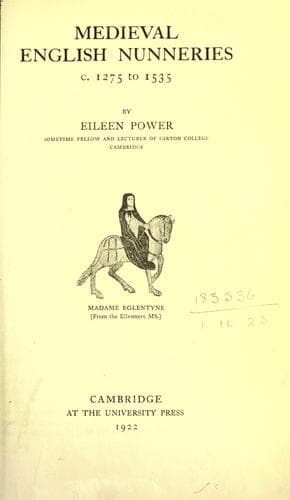
Medieval English Nunneries c. 1275 to 1535Power, Eileen
History
Medieval English Nunneries c. 1275 to 1535
Power, Eileen
Convents -- England; Monastic and religious life of women -- History
Another class of gifts which deserves some notice consists of gratuities
to friends, well-wishers or dependents of the house, for benefits
solicited or received. No one in the middle ages was too dignified to
receive a tip. The nuns of St Michael's, Stamford, regularly give what
they euphemistically term "gifts" or "courtesies" to a large number of
persons, ranging from their own servants at Christmas to men of law,
engaged in the various suits in which they were involved. To the high and
mighty they present wine, or a capon, or money discreetly jingling in the
depths of a silken purse. To the lowly they present a plain unvarnished
tip. The nuns of St Radegund's, Cambridge, pay 12_d._ "for a crane bought
and given to the chancellor of the university of Cambridge, for his good
friendship in divers of my lady's affairs in the interest of the convent";
and "the four waits of the Mayor of Cambridge" receive a Christmas box of
2_s._ 3_d._ "for their services to the lady Prioress and convent." _Dono
Data_ is a regular heading in their accounts, and in 1450-1 there is a
long list of small gifts to dependents, ranging from 1_d._ to 10_d._, and
a sum of 2_s._ for linen garments bought for gifts at Christmas[344].
Similarly the cellaress of Syon in 1536-7 gave her servants at Christmas a
reward of 20_s._ "with their aprons"[345]. Whether to ensure that a
lawsuit should go in favour of the convent, or merely to reward faithful
service or to celebrate a feast, such payments were well laid out and no
careful housekeeper could afford to neglect them.
(2) _Divers expenses_ include payments for various fines, amercements and
legal expenses and also for the numerous journeys undertaken by the
prioress or by their servants on convent business. The legal expenses
which fell upon the nuns of St Michael's, Stamford, ranged from a big suit
in London and various cases over disputed tithes at the court of the
bishop of Lincoln, to divers small amercements, when the convent pigs
"trespassed in Castle meadow"[346]. The payments for journeys often give a
vivid picture of nuns inspecting their manors and visiting their
bishop[347]. Under this heading is also included a payment for ink and
parchment and for the fee of the clerk who wrote out the account.
Public-domain text, read in full here on John Shaqi.
Reviews
Reviews
No reviews yet
Be the first to share your thoughts on this work.
Elsewhere in the archive
Join the Discussion
Join the discussion
Sign in to leave a comment or review.
Sign InorCreate an account