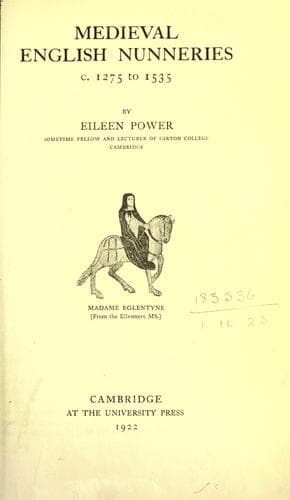
Medieval English Nunneries c. 1275 to 1535Power, Eileen
History
Medieval English Nunneries c. 1275 to 1535
Power, Eileen
Convents -- England; Monastic and religious life of women -- History
v contre oxen and iij western oxen fatt, ... xviij leane contre oxen
workers, xij leane contre sterys of ij or iij yere age, xxviij
yeryngs, xxxviii kene and heifors ... xxvi cattle of thys yere, an
horse, j olde baye, a dunne, a whyte and an amblelyng grey, vj
geldings and horse for the plow and harowe, with v mares, xliij hogges
of dyvers sorts, in wethers and lammys cccc{xxx}, ... and in beryng
ewes vij{c}, ... in twelvemonthyngs, ewes and wethers vi{c}xxxv ... in
lambys at this present daye v{c}lx[349].
How these lean country oxen, the "one old bay, a dun, a white and an
ambling grey," bring the quiet English landscape before the reader's eyes.
Time is as nothing; and the ploughman trudging over the brown furrows, the
slow, warm beasts, breathing heavily in the darkness of their byre, are
little changed from what they were five hundred years ago--save that our
beasts to-day are larger and fatter, thanks to turnips and Mr Bakewell.
Kingdoms rise and fall, but the seasons never alter, and the farm servant,
conning these old accounts, would find nothing in them but the life he
knew:
This is the year's round he must go
To make and then to win the seed:
In winter to sow and in March to hoe
Michaelmas plowing, Epiphany sheep;
Come June there is the grass to mow,
At Lammas all the vill must reap.
From dawn till dusk, from Easter till Lent
Here are the laws that he must keep:
Out and home goes he, back-bent,
Heavy, patient, slow as of old
Father, granfer, ancestor went
O'er Sussex weald and Yorkshire wold.
O what see you from your gray hill?
The sun is low, the air all gold,
Warm lies the slumbrous land and still.
I see the river with deep and shallow,
I see the ford, I hear the mill;
I see the cattle upon the fallow;
And there the manor half in trees,
And there the church and the acre hallow
Where lie your dead in their feretories....
I see the yews and the thatch between
The smoke that tells of cottage and hearth,
And all as it has ever been
From the beginning of this old earth[350].
The farm labourer to-day would well understand all these items of
expenditure, which the monastic treasuress laboriously enters in her
account. He would understand that heavy section headed "Repair of Carts
and Ploughs." He would understand the purchases of grain for seed, or for
the food of livestock, of a cow here, a couple of oxen there, of whip-cord
and horse-collars, traces and sack-cloth and bran for a sick horse. Farm
expenses are always the same. The items which throw light on sheep-farming
are very interesting, in view of the good income which monastic houses in
pastoral districts made by the sale of their wool. The Prioress of
Catesby's account for 1414-5 notes:
Public-domain text, read in full here on John Shaqi.
Reviews
Reviews
No reviews yet
Be the first to share your thoughts on this work.
Elsewhere in the archive
Join the Discussion
Join the discussion
Sign in to leave a comment or review.
Sign InorCreate an account