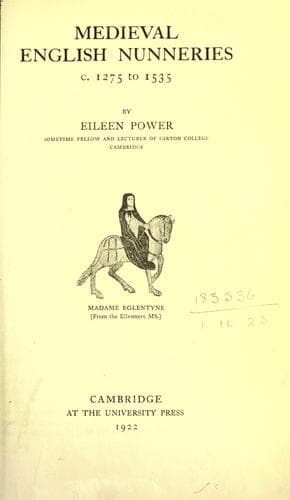
Medieval English Nunneries c. 1275 to 1535Power, Eileen
History
Medieval English Nunneries c. 1275 to 1535
Power, Eileen
Convents -- England; Monastic and religious life of women -- History
(3) The _household staff_ naturally varied in size with the size of the
nunnery. The Rule of St Benedict contemplated the performance of a great
deal if not all of the necessary domestic and agricultural work of a
community by the monks themselves. But this tradition had been largely
discarded by the thirteenth century, and if the nuns of a small convent
are found doing their own cooking and housework, it is by reason of their
poverty and they not infrequently complain at the necessity. They were of
gentle birth and ill accustomed to menial tasks. The weekly service in the
kitchen would seem to have disappeared completely. The larger houses
employed a male cook, sometimes assisted by a page, or by his wife, and
supervised by the cellaress, or by the kitcheness, where this obedientiary
was appointed. There were also a maltster, to make malt, and a brewer and
baker, to prepare the weekly ration of bread and ale; sometimes these
offices were performed by men, sometimes by women. There was a _deye_ or
dairy-woman, who milked the cows, looked after the poultry, and made the
cheeses. There was sometimes a _lavender_ or laundress, and there were one
or more women servants, to help with the housework and the brewing. The
gate was kept by a male porter; and there was sometimes also a gardener.
In large houses there would be more than one servant for each of these
offices; in small houses the few servants were men or maids of all work
and extra assistance was hired when necessary for making malt or washing
clothes. In large houses it was not uncommon for each of the chief
obedientiaries to have her own servant attached to her _checker_ (office)
and household, who prepared the meals for her mistress and for those nuns
who formed her _familia_ and messed with her. The head of the house nearly
always had her private servant when its resources permitted her to do so,
and sometimes when they did not.
(4) _The farm labourers._ Finally every house which had attached to it a
home farm had to pay a staff of farm labourers. These hinds, whose work
was superintended by the bailiff and cellaress, always included one or two
ploughmen, a cowherd and oxherd, a shepherd, probably a carter or two and
some general labourers. Again the number varied very considerably
according to the size of the house and was commonly augmented by hiring
extra labour at busy seasons. The farm was cultivated partly by the work
of these hired servants, partly by the services owed by the villeins.
Public-domain text, read in full here on John Shaqi.
Reviews
Reviews
No reviews yet
Be the first to share your thoughts on this work.
Elsewhere in the archive
Join the Discussion
Join the discussion
Sign in to leave a comment or review.
Sign InorCreate an account