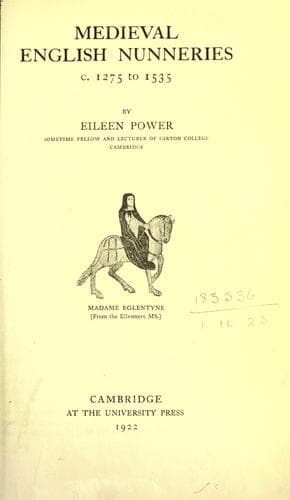
Medieval English Nunneries c. 1275 to 1535Power, Eileen
History
Medieval English Nunneries c. 1275 to 1535
Power, Eileen
Convents -- England; Monastic and religious life of women -- History
The support of resident corrodians and the payment of pensions and
liveries were, however, less onerous than the duty of providing
hospitality for visitors, which the nunneries performed as one of their
religious obligations. _Date_ and _Dabitur_ did not always accompany each
other. The great folk who held the Pope's indult to enter the houses of
Minoresses were probably generous donors; but the unenclosed orders had to
lodge and feed less wealthy guests and often enough they found the
obligation a strain upon their finances. When the nuns of King's Mead,
Derby, in 1326, petitioned the King to take the house into his special
protection, they explained that great numbers of people came there to be
entertained, but that owing to the reduction in their revenue they were
unable to exercise their wonted hospitality[640]; and the number of guests
was mentioned by the nuns of Heynings in 1401 as one reason for their
impoverishment[641]. At Nunappleton in 1315 the Archbishop of York had to
forbid two sets of guests to be received at the same time, until the house
should be relieved of debt; and at Moxby (which was also in debt) he
ordained that relatives of the nuns were not to visit the house for a
longer period than two days; Nunappleton was evidently a favourite resort,
for in 1346 another archbishop speaks of guests flocking--_hospites
confluentes_--to the priory and orders them to be admitted to a hostelry
constructed for the purpose. At Marrick in 1252 it was ordered that
guests were not to stay for more than one night, because the means of the
house barely sufficed for the maintenance of the nuns, sisters and
brethren[642].
Another charge which fell heavily upon the nunneries, sometimes not
entirely by their own fault, was that of litigation. This was only an
occasional expense, but when it occurred it was heavy, and a suit once
begun might drag on for years. Moreover the incidental expenses in
journeys and bribes, which all had to be paid out of the current income of
a house already (perhaps) charged with the payment of tithes and taxes and
badly in need of repair, were often almost as heavy as the costs of the
litigation. For instance an account of Christian Bassett, Prioress of St
Mary de Pre (near St Albans), contains the following list of expenses
incurred by her in the prosecution of a law suit in 1487, during the rule
of her predecessor Alice Wafer:
Public-domain text, read in full here on John Shaqi.
Reviews
Reviews
No reviews yet
Be the first to share your thoughts on this work.
Elsewhere in the archive
Join the Discussion
Join the discussion
Sign in to leave a comment or review.
Sign InorCreate an account