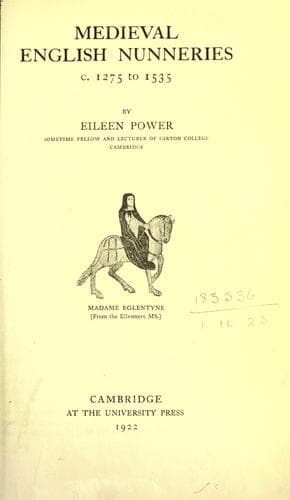
Medieval English Nunneries c. 1275 to 1535Power, Eileen
History
Medieval English Nunneries c. 1275 to 1535
Power, Eileen
Convents -- England; Monastic and religious life of women -- History
Besides cases of incompetence and cases of misappropriation of revenues by
an unscrupulous prioress, the mismanagement of the nuns may usually be
traced to a desperate desire to obtain ready money. One means by which
they sought to augment their income was by the sale of corrodies in return
for a lump sum[666]. A man (or woman) would pay down a certain sum of
money, and in return the convent would engage to keep him in board and
lodging for the rest of his natural life; at Arden for instance, in 1524,
Alice widow of William Berre paid twelve pounds and was granted "mett and
drynke as their convent hath" at their common table, or when sick in her
own room, and "on honest chamber with sufficient fyer att all tyme, with
sufficient apperell as shalbe nedful"[667]. Obviously, however, such an
arrangement could only be profitable to the nuns, if the grantee died
before the original sum had been expended in boarding her. The convent, in
fact, acted as a kind of insurance agency and the whole arrangement was
simply a gamble in the life of the corrodian. The temptation to extricate
themselves from present difficulties by means of such gambles, was one
which the nuns could never resist. They would lightly make their grant of
board and lodging for life and take the badly needed money; but it would
be swallowed up only too soon by their creditors and often vanish like
fairy gold in a year. Not so the corrodian. Long-lived as Methusaleh and
lusty of appetite, she appeared year after year at their common table,
year after year consumed their food, wore their apparel, warmed herself
with their firewood. Alice Berre was still hale and hearty after twelve
years, when the commissioners came to Arden and would doubtless have
lasted for several more to come, if his Majesty's quarrel with Rome had
not swept her and her harassed hostesses alike out of their ancient home;
but she must long before have eaten through her original twelve
pounds[668]. There is an amusing complaint in the Register of Crabhouse;
early in the fourteenth century Aleyn Brid and his wife persuaded the nuns
to buy their lands for a sum down and a corrody for their joint and
separate lands. But the lands turned out barren and the corrodians went on
living and doubtless chuckling over their bargain, and "si cher terre de
cy petit value unkes ne fut achate," wrote the exasperated chronicler of
the house[669]. Bishop Alnwick found two striking instances of a bad
gamble during his visitations in 1440-1; at Langley the late Prioress had
sold a corrody to a certain John Fraunceys and his wife for the paltry sum
of twenty marks, and they had already held it for six years[670]; worse
still, at Nuncoton there were two corrodians, each of whom had originally
paid twenty marks, and they had been there for twelve and for twenty
years respectively[671].
Public-domain text, read in full here on John Shaqi.
Reviews
Reviews
No reviews yet
Be the first to share your thoughts on this work.
Elsewhere in the archive
Join the Discussion
Join the discussion
Sign in to leave a comment or review.
Sign InorCreate an account