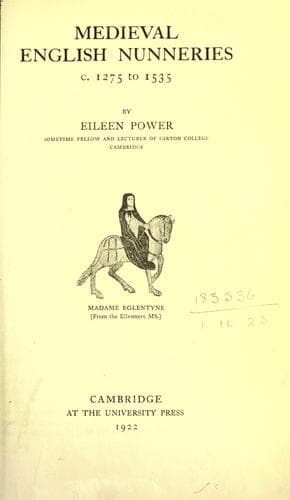
Medieval English Nunneries c. 1275 to 1535Power, Eileen
History
Medieval English Nunneries c. 1275 to 1535
Power, Eileen
Convents -- England; Monastic and religious life of women -- History
liveries or pensions to clerics or to laymen, save with our licence
first sought and obtained[754].
At Elstow Bokyngham gave a more detailed injunction about the appointment
of bailiffs and other officers.
Let the Abbess for the government of the aforesaid monastery have
faithful servants, in especial for the government and supervision
without waste of the husbandry and the manors and stock and woods of
the aforesaid house; the which the Abbess herself is bound, if she
can, to supervise each year in person, or else let her cause them to
be industriously supervised by others; and to look after the external
and internal business of the house and to prosecute it outside let her
appoint also some man of proven experience and of mature age[755].
The purpose of those regulations and restrictions which have hitherto been
described, was to assist the nuns in managing their own finances. But the
nuns were never very good business women, and they were moreover in theory
confined to the precincts of the cloister, so that it was difficult for
them to manage their own business, unless they imperilled their souls by
excursions into the world. During the thirteenth and early fourteenth
centuries, therefore, a common method of extricating them from their
difficulties was by appointing a male guardian, known in different places
as Custos, Prior, Warden or Master, to supervise the temporal affairs of a
house and to look after its finances. In the early history of Cistercian
nunneries each house was governed jointly by a Prior and Prioress and in
some cases a few canons are found holding the temporalities jointly with
the nuns. Of these Cistercian houses Mr Hamilton Thompson says:
As in the case of the Gilbertine priories, such nunneries are rarely
found outside Lincolnshire and Yorkshire: they were under the bishop's
supervision and their connexion with the order of Citeaux was nominal.
Their geographical distribution, as well as the fact that St Gilbert
attempted to affiliate his nunneries to the Cistercian order and
modelled them upon its rule, provokes the suspicion that such houses
were a result of the growth of the Gilbertine order, and, if not
intended to become double houses, were at any rate imitations of the
corporations of nuns at Sempringham and elsewhere[756].
References to canons occur in connection with the houses of Stixwould,
Heynings and Legbourne in Lincolnshire[757], Catesby in
Northamptonshire[758] and Swine in Yorkshire[759]. The _comperta_ of
Archbishop Giffard's visitation of Swine in 1267-8 show that the house at
that time closely resembled the double houses belonging to the Gilbertine
order.
Public-domain text, read in full here on John Shaqi.
Reviews
Reviews
No reviews yet
Be the first to share your thoughts on this work.
Elsewhere in the archive
Join the Discussion
Join the discussion
Sign in to leave a comment or review.
Sign InorCreate an account