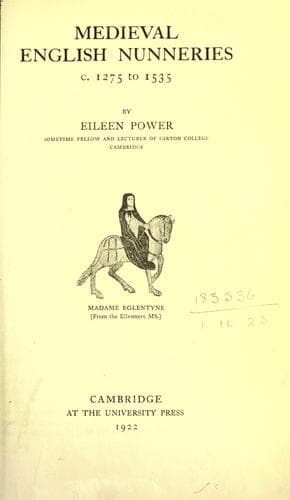
Medieval English Nunneries c. 1275 to 1535Power, Eileen
History
Medieval English Nunneries c. 1275 to 1535
Power, Eileen
Convents -- England; Monastic and religious life of women -- History
under the guardianship of the rectors of Kirk Deighton, Sutton-on-Derwent
and Kippax respectively, and he made the vicars of Thirkleby and Bossall
successively masters of Moxby[770]. Bishop Dalderby of Lincoln appointed
neighbouring rectors and vicars to be masters of Legbourne, Godstow,
Rowney, Sewardsley, Fosse, Delapre, St Leonard's Grimsby, and
Nuncoton[771].
Sometimes, on the other hand, canons or monks of religious houses in the
vicinity were charged with looking after the affairs of nunneries. Swine
was managed by Robert de Spalding, a canon of the Premonstratensian house
of Croxton, and in 1289-90 Archbishop Romeyn wrote remonstrating with the
Abbot of Croxton for recalling him, and begging that he might be allowed
to continue at Swine, "cum idem vester canonicus proficuos labores ibidem
impenderit ad relevacionem probabilem depressionis notorie dicte domus";
but the capable Robert was not allowed to return and in 1290 John Bustard,
canon of St Robert's Knaresborough, was appointed in his place. John was
not a success and the next year the Abbot removed him; in 1295 Robert of
Spalding became master again and in 1298 the rector of Londesborough was
appointed[772]. At Catesby in 1293 the office of master was held by a
certain Robert de Wardon, a canon of Canons Ashby, who had apparently left
the nuns and gone back to his own house, to the great detriment of the
nunnery, for Bishop Sutton wrote in 1293 to the Prior of Canons Ashby,
bidding him send back the truant[773]. Similarly a canon of Wellow is
found as warden of St Leonard's Grimsby in 1232 and in 1303[774], a monk
of Whitby as guardian of Handale and Basedale in 1268[775], a canon of
Newburgh at Arden in 1302[776] and a canon of Lincoln at Heynings in 1291:
concerning the latter Bishop Sutton wrote to the nuns that since, "because
of private business and various other impediments he is prevented from
looking after your business as much as it requires, the vicar of Upton
your neighbour is to look after your affairs in his absence," and in 1294
he was definitely replaced by the rector of Blankney[777]. It is clear
from this letter that the masters of nunneries could be non-resident and
this was no doubt usually the case when the office was held by the rector
of a neighbouring parish. Indeed sometimes the same man would be master of
more than one nunnery; as in the case of the monk of Whitby mentioned
above. It was probably rare after the beginning of the fourteenth century
for a _custos_ to reside at a nunnery, as the early Cistercian priors had
done[778].
Public-domain text, read in full here on John Shaqi.
Reviews
Reviews
No reviews yet
Be the first to share your thoughts on this work.
Elsewhere in the archive
Join the Discussion
Join the discussion
Sign in to leave a comment or review.
Sign InorCreate an account