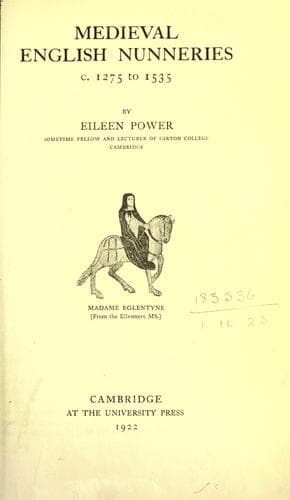
Medieval English Nunneries c. 1275 to 1535Power, Eileen
History
Medieval English Nunneries c. 1275 to 1535
Power, Eileen
Convents -- England; Monastic and religious life of women -- History
Reference to the sale of embroidery by nuns is surprisingly rare in
account rolls. The household roll of the Countess of Leicester in 1265
contains an item, "Paid to the nuns of Wintney, for one cope to be made
for the use of Brother J. Angelus by the gift of the Countess at Panham
10_d._"[862], which small sum must have been a part payment in advance,
perhaps towards the purchase of materials; the nuns of Gracedieu, too,
sold a cope to a neighbouring rector for L10, early in the fifteenth
century[863], and on one occasion the cellaress of Barking derived a part
of her income for the year from the sale of a cope[864], but search has
revealed no further instances. The nuns also probably made little presents
for their friends, such as purses (though the Gracedieu nuns always bought
the purses which they gave to their bailiff, to Lady Beaumont, or to other
visitors) and the so-called "blood-bands." In an age when bleeding was the
most common treatment for almost every illness and when monks, in
particular, were regularly bled several times a year, these little
bandages were common presents, being sometimes made of silk. The author of
the _Ancren Riwle_ thus bade his anchoresses "make no purses to gain
friends therewith, not blodbendes of silk, but shape and sew and mend
church vestments and poor people's clothes"[865]. The nuns of the diocese
of Rouen in the mid-thirteenth century were accustomed to knit or
embroider silken purses, tassels, cushions or needlecases for sale or as
gifts, and Archbishop Eudes Rigaud was continually forbidding them to do
any silk work except for church ornament[866]. There is some reason to
think that the nuns, then as now, sometimes eked out their income by doing
fine needlework for ladies of the world, though there is no mention of it
in nunnery accounts, or indeed in any English records. Among the
correspondence of Lady Lisle in the first half of the sixteenth century,
however, are several letters to and from a certain Antoinette de Favences
at Dunkirk, who would appear to have been a nun, for she signs herself
_sister_ Antoinette de Favences and is addressed by Lady Lisle as _Madame_
and _Dame_. This woman was employed to make caps and coifs for Lady
Lisle's family and friends and there is much correspondence between them
as to night-caps which are too wide, lozenge-work and such matters; in one
letter Lady Lisle speaks of sending "16 rozimbos and 2 half angels of
Flanders, a Carolus of gold," in payment for the caps[867].
What other accomplishments the nuns may have possessed we do not know.
They were possibly skilled in herbs and in the more simple forms of home
medicine and surgery, for it was the function of the lady of the manor to
know something of these things, though doctors were available (for nuns as
well as for lay folk) in more serious illnesses[868]. They doubtless bled
each other as did the monks, else how was the wicked Prioress of Kirklees,
who slew Robin Hood, so skilled?:
Public-domain text, read in full here on John Shaqi.
Reviews
Reviews
No reviews yet
Be the first to share your thoughts on this work.
Elsewhere in the archive
Join the Discussion
Join the discussion
Sign in to leave a comment or review.
Sign InorCreate an account