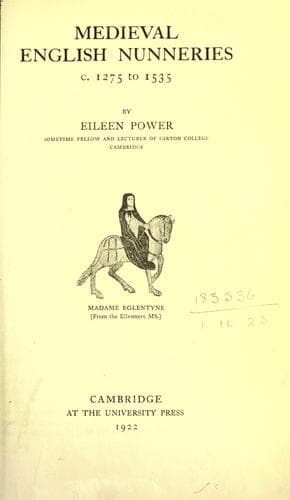
Medieval English Nunneries c. 1275 to 1535Power, Eileen
History
Medieval English Nunneries c. 1275 to 1535
Power, Eileen
Convents -- England; Monastic and religious life of women -- History
A word should perhaps be added as to the "piety and breeding," which Lady
Bridget and other little schoolgirls learned from the nuns, for good
sentimentalists of later days often looked back and regretted the loss of
a training, presumably instinct with religion and morality. It is well
nigh impossible to generalise in this matter, so greatly did convents
differ from each other. St Mary's Winchester was of very good repute, and
for this we have not only the testimony of the local gentlemen, who were
commissioned to visit it by Henry VIII in 1536, but also of the visitation
which was held by Dr Hede in 1501. Undoubtedly the aristocratic young
ladies who went there did not lack the precept and example of pious and
well bred mistresses. The statement of the commissioners at Polesworth
that the children there were "right virtuously brought up" has often been
quoted. So also has the plea of Robert Aske, who led the ill-fated
Pilgrimage of Grace, by which the people of Yorkshire sought to bring back
the old religion, and in particular the monastic houses; in the abbeys, he
said, "all gentlemen (were) much succoured in their needs, with many their
young sons there assisted and in nunneries their daughters brought up in
virtue"[903]. Less well-known is the tribute of the reformer Thomas Becon
(1512-67), the more striking in that he was a staunch Protestant, who had
suffered for his faith. Although he refers in disparagement to the
nunneries of his own day, his description of the relations between nuns
and their pupils cannot be founded solely upon an imaginary golden age:
Public-domain text, read in full here on John Shaqi.
Reviews
Reviews
No reviews yet
Be the first to share your thoughts on this work.
Elsewhere in the archive
Join the Discussion
Join the discussion
Sign in to leave a comment or review.
Sign InorCreate an account