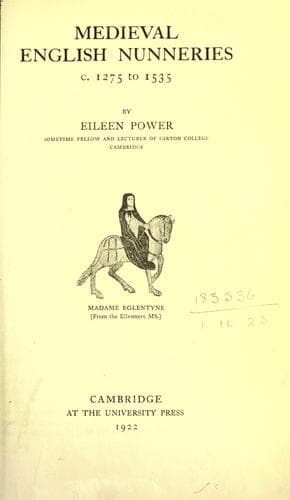
Medieval English Nunneries c. 1275 to 1535Power, Eileen
History
Medieval English Nunneries c. 1275 to 1535
Power, Eileen
Convents -- England; Monastic and religious life of women -- History
These eulogies are all necessarily tinged by the knowledge that the
nunneries either were about to disappear, or had disappeared, from
England. They had filled a useful function and men were willing to be to
their faults a little blind. It cannot be doubted that the gentry and the
substantial middle class appreciated them; up to the very eve of the
Dissolution legacies to monastic houses are a common feature in wills.
Only an inadequate conclusion, however, is to be reached from a study of
tributes such as those of the commissioners at St Mary's Winchester and
Polesworth and of Robert Aske. If we turn to pre-Reformation visitation
reports, which are free from the desire to state a case, the evidence is
more mixed. It is only reasonable to conclude that many nunneries did
indeed bring children up, with the example of virtue before their eyes,
and the _omnia bene_ of many reports reinforces such a conclusion. But it
is impossible also to avoid the conviction that other houses were not
always desirable homes for the young, nor nuns their best example. When
Alnwick visited his diocese in the first half of the fifteenth century
there were children at Godstow, where at least one nun was frankly immoral
and where all received visits freely from the scholars of Oxford; nor was
the general reputation of the house good at other periods. There were
children also at Catesby and at St Michael's Stamford, which were in a
thoroughly bad state, under bad prioresses. At Catesby the poor innocents
lay in the dorter, where lay also sister Isabel Benet, far gone with
child; and they must have heard the Prioress screaming "Beggars!" and
"Whores!" at the nuns and dragging them round the cloister by their
hair[905]. At St Michael's Stamford, all was in disorder and no less than
three of the nuns were unchaste, one having twice run away, each time with
a different partner. The visitation of Gracedieu on the same occasion
shows too much quarrelling and misrule to make possible a very high
opinion of its piety or of its breeding. If we turn to another set of
injunctions, the great series for the diocese of York, it must be conceded
that though the gentry of the county doubtless found the convents useful
as schools and lodging houses, it is difficult to see how Aske's plea that
"their daughters (were) brought up in virtue" could possibly have been
true of the fourteenth century, when the morals and manners of the nuns
were extremely bad. There is not much evidence for the period of which
Aske could speak from his own knowledge; but at Esholt, where two children
were at school in 1537, one of the nuns was found to have "lyved
incontinentlie and vnchast and ... broght forth a child of her bodie
begotten" and an alehouse had been set up within the convent gates, in
1535[906]. The only safe generalisation to make about this, as about so
many other problems of medieval social history, is that there can be no
generalisation.
Public-domain text, read in full here on John Shaqi.
Reviews
Reviews
No reviews yet
Be the first to share your thoughts on this work.
Elsewhere in the archive
Join the Discussion
Join the discussion
Sign in to leave a comment or review.
Sign InorCreate an account