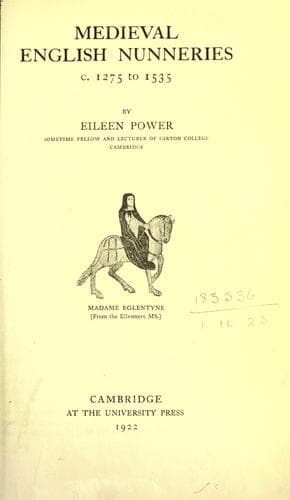
Medieval English Nunneries c. 1275 to 1535Power, Eileen
History
Medieval English Nunneries c. 1275 to 1535
Power, Eileen
Convents -- England; Monastic and religious life of women -- History
The nuns of Syon had a table of signs drawn up for them by Thomas Betsone,
one of the brethren of the house, a person of extraordinary ingenuity and
no sense of humour[910]. The sort of dumb pandemonium which went on at the
Syon dinner table must have been more mirth provoking than speech. The
sister who desired fish would "wagge her hande displaied sidelynges in
manere of a fissh taill," she who wanted milk would "draw her left little
fynger in maner of mylkyng"; for mustard one would "hold her nose in the
uppere part of her righte fiste and rubbe it," and another for salt would
"philippe with her right thombe and his forefynger ouere the left thombe";
another, desirous of wine, would "meue her fore fynger vp and downe vpon
the ende of her thombe afore her eghe"; and the guilty sacristan, struck
by the thought that she had not provided incense for the mass, would "put
her two fyngers vnto her nose thirles (nostrils)." There are no less than
106 signs in the table and on the whole it is not surprising that the Rule
enjoins that "it is never leful to use them witheoute some reson and
profitable nede, ffor ofte tyme more hurt ethe an euel sygne than an euel
worde, and more offence it may be to God"[911].
[Illustration: PLATE VI
DOMINICAN NUNS IN QUIRE]
The time set apart in the monastic day for work was divided between brain
work and manual labour. In the golden days of monasticism the time devoted
to reading enabled the monasteries to become homes of learning; splendid
libraries were collected for the use of the monks and in the scriptorium
men skilled in writing and in illumination copied books and maintained the
great series of chronicles, in which the middle ages live again. The nuns
of certain Anglo-Saxon houses, and of certain continental houses at a
later date, had some reputation for learning. In early days, too, the
hours devoted to labour were spent in the fields, or more often in the
workshops of the house; and those who had been skilled in crafts in the
world continued to exercise them. The nuns of Anglo-Saxon England were
famed for the needlework executed during the hours of work. Besides this
labour the Rule ordained that the monks and nuns should take it in turns
to serve their brethren in the kitchen every week and an eleventh century
chronicler records "in the monasteries I saw counts cooking in the
kitchens and margraves leading the pigs out to feed"[912]. It was by
reason of this intellectual and manual labour that the early monks
rendered, as it were incidentally, an immense service to civilisation.
Their aim and purpose was the salvation of their souls, but because the
Rule under which they lived declared that labour was one of the means to
that salvation, they added many of the merits of the active to those of
the contemplative life. The early Benedictines were great missionaries,
ardent scholars, enlightened landowners and even energetic statesmen. The
Public-domain text, read in full here on John Shaqi.
Reviews
Reviews
No reviews yet
Be the first to share your thoughts on this work.
Elsewhere in the archive
Join the Discussion
Join the discussion
Sign in to leave a comment or review.
Sign InorCreate an account