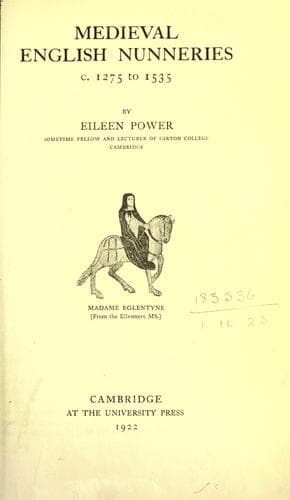
Medieval English Nunneries c. 1275 to 1535Power, Eileen
History
Medieval English Nunneries c. 1275 to 1535
Power, Eileen
Convents -- England; Monastic and religious life of women -- History
since, according to the constitutions of the holy fathers, younger
members must take a pattern from their rulers (_prelati_) and those
prelates ought to have a number of witnesses to their own behaviour,
we strictly order you (lady abbess) in virtue of obedience, that you
annually commit the office of chaplain to one of your nuns ... and
thus the nuns themselves, who shall have been with you in the
aforesaid office, shall (by means of laudable instruction) be the
better enabled to excel in religion, while you will be able
immediately to invoke their testimony to your innocence, if (which God
forbid) any crime or scandal should be imputed to you by the malice of
any person[194].
So at Easebourne in 1478 the Prioress was ordered
that every week, beginning with the eldest ... she should select for
herself in due course and in turns, one of her nuns as chaplain for
divine services and to wait upon herself[195].
The Norwich visitations of Bishop Nykke afford further information; at
Flixton discontented Dame Margaret Punder complained that the Prioress had
no sister as chaplain, but slept alone as she pleased, in a chamber
(_cubiculo_) outside the dorter, "without the continual testimony of her
sisters," and the visitors enjoined that henceforth she should have with
her one sister in the office of chaplain for a witness, and especially
when she slept outside the dorter[196]. At Blackborough one of the nuns
complained that the Prioress had kept the same chaplain for three
years[197] and at Redlingfield it was said that she never changed her
chaplain[198]; the Abbess of Elstow in 1421-2[199] and the Prioress of
Markyate in 1442[200] were ordered to change their chaplains every year,
and this seems to have been the customary arrangement. The title of
"chaplain" is sometimes found after the name of a nun in lists of the
inmates of nunneries[201].
Besides the temptation to live too independent an existence the head of a
house had also the temptation to abuse the considerable power given to her
by the monastic rule. She was apt to govern autocratically, keeping the
business of the house entirely in her own hands, instead of consulting her
sisters (assembled in chapter) before making any important decision. There
were constant complaints by the nuns that the Prioress kept the common
seal in her own custody and performed all business without consulting
them. Peckham's letter to the Abbess of Romsey illustrates the variety of
matters which might thus be settled without any reference to the nuns; she
had evidently been misusing her power, for he wrote sternly:
Public-domain text, read in full here on John Shaqi.
Reviews
Reviews
No reviews yet
Be the first to share your thoughts on this work.
Join the Discussion
Join the discussion
Sign in to leave a comment or review.
Sign InorCreate an account