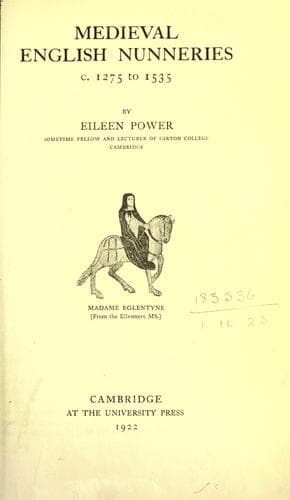
Medieval English Nunneries c. 1275 to 1535Power, Eileen
History
Medieval English Nunneries c. 1275 to 1535
Power, Eileen
Convents -- England; Monastic and religious life of women -- History
at Greenfield (1519) there was a complaint that the Prioress did not
invite the nuns to her table in due order, and at Stainfield it was said
that she frequently invited three young nuns to her table and showed
partiality to them and she was ordered to invite all the senior sisters in
order[188]. In Cistercian and Cluniac houses the superior was supposed to
dine in the frater and to sleep in the dorter with the other nuns, and
even in Benedictine houses it was considered desirable that she should do
so. But the temptation to live a more private life was irresistible, and
visitation records contain many complaints that the head of the house is
lax in her attendance at dorter and frater and even in following the
divine services in the choir[189]. Bishops frequently made injunctions
like that given by Alnwick to the Prioress of Ankerwyke in 1441:
that nyghtly ye lygge in the dormytorye to ouersee your susters how
thai are there gouernede after your rewle, and that often tyme ye come
to matynes, messe and other houres ... also that oftentymes ye come to
the chapitere for to correcte the defautes of your susters ... also
that aftere your rewle ye kepe the fraytour but if resonable cause
excuse yowe there fro[190].
Sometimes a minimum number of attendances was demanded. At St Michael's
Stamford Alnwick ordered the old Prioress
that nyghtly ye lyg in the dormytorye emong your susters and that
euery principale double fest and festes of xij or ix lessouns ye be at
matynes, but if grete sekenes lette yowe; and that often tymes ye be
at other howres and messes in the qwere, and also that ye be present
in chapitres helpyng the supprioresse in correctyng and punisshyng of
defautes[191].
It was further attempted to restrict the dangerous freedom of a superior's
life, by ordering her always to have with her one of the nuns as a
companion and as witness to her behaviour. So Peckham ordered the Abbess
of Romsey to "elect a suitable companion for herself and to change her
companions yearly, to the end that her honesty should be attested by many
witnesses"[192]. Usually the nun whose duty it was to accompany the
superior acted as her chaplain. It will be remembered that Chaucer says of
his Prioress "another Nonne with hir hadde she, That was hir
chapeleyne"[193], and episcopal registers contain frequent allusions to
the office. William of Wykeham gave a comprehensive account of its purpose
when he wrote to the Abbess of Romsey in 1387,
Public-domain text, read in full here on John Shaqi.
Reviews
Reviews
No reviews yet
Be the first to share your thoughts on this work.
Join the Discussion
Join the discussion
Sign in to leave a comment or review.
Sign InorCreate an account