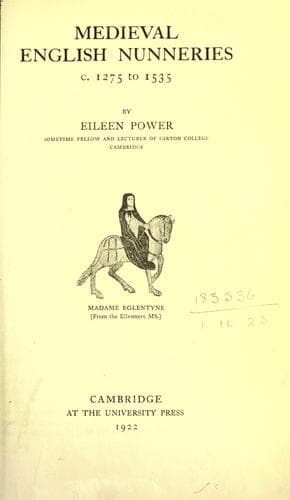
Medieval English Nunneries c. 1275 to 1535Power, Eileen
History
Medieval English Nunneries c. 1275 to 1535
Power, Eileen
Convents -- England; Monastic and religious life of women -- History
anywhere within the city and diocese of Salisbury[220].
It is significant that among the arguments used to oppose Henry VIII's
injunction that monks and nuns should be strictly enclosed (which was, for
the nuns, only a repetition of Pope Boniface's decree of three centuries
earlier) was that of the difficulty of supervising the husbandry of a
house, if its head were confined to cloistral precincts.
"Please it you to be advertised," wrote Cecily Bodenham, the last
Abbess of Wilton, to Cromwell in 1535, "that master doctor Leigh, the
King's grace's special visitor and your deputy in this behalf,
visiting of late my house, hath given injunction that not only all my
sisters, but I also, should continually keep and abide within the
precincts of my house: which commandment I am right well content with
in regard of my own person, if your mastership shall think it so
expedient; but in consideration of the administration of mine office
and specially of this poor house which is in great debt and requireth
much reparation and also which without good husbandry is not like, in
long season, to come forward, and in consideration that the said
husbandry cannot be, by my poor judgment, so well by an other overseen
as by mine own person, it may please your mastership of your goodness
to license me, being associate with one or two of the sad and discreet
sisters of my house, to supervise abroad such things as shall be for
the profit and commodity of my house. Which thing though,
peradventure, might be done by other, yet I ensure you that none will
do it so faithfully for my house's profit as mine own self. Assuring
your mastership that it is not, nor shall be at any time hereafter, my
mind to lie forth of my monastery any night, except by inevitable
necessity I cannot then return home"[221].
It is, however, very plain that the journeys taken by abbesses and
prioresses were not always strictly concerned with the business of their
convents, or at least they combined business most adroitly with pleasure.
These ladies were of good kin and they took their place naturally in local
society, when they left their houses to oversee their husbandry, to
interview a bishop or a lawyer about their tithes, or quite openly to
visit friends and relatives. They emerged to attend the funerals of great
folk; the Prioress of Carrow attended the funeral of John Paston in
1466[222], and Sir Thomas Cumberworth in his will (1451) left the
injunction:
I will that Ilke prior and priores that comes to my beryall at y{t}
day hafe iii_s_ iiij_d_ and ilke chanon and Nune xij_d_ ... and Ilke
prior and priores that comes to the xxx day (the month's-mind) hafe
vj_s_ viij_d_ and Ilke chanon or none that comes to the said xxx day
haf xx_d_[223].
Public-domain text, read in full here on John Shaqi.
Reviews
Reviews
No reviews yet
Be the first to share your thoughts on this work.
Elsewhere in the archive
Join the Discussion
Join the discussion
Sign in to leave a comment or review.
Sign InorCreate an account