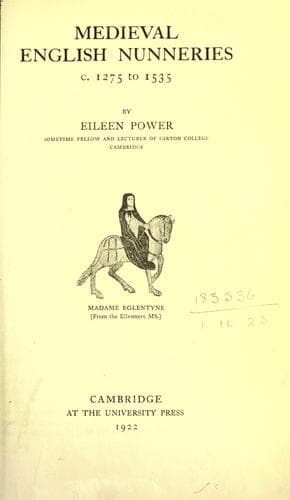
Medieval English Nunneries c. 1275 to 1535Power, Eileen
History
Medieval English Nunneries c. 1275 to 1535
Power, Eileen
Convents -- England; Monastic and religious life of women -- History
The accounts of St Michael's Stamford are full of items such as "in the
expenses of the Prioress on divers occasions going to the Bishop, with
hire of horses 3_s._" "in the expenses of the Prioress going to Rockingham
about our woods 1_s._ 2-1/2_d._," "paid for the hire of two horses for the
prioress and her expenses going to Liddington to the Bishop for a
certificate 2_s._ 8_d._," "paid for the expenses of the Prioress at Burgh
(i.e. Peterborough) for two days 5_s._ 8_d._"; twice the Prioress went
very far afield, as usual (it would appear) on legal business, for in
1377-8 there is an entry, "Item for the expenses of the Prioress and her
companions at London for a month and more, in all expenses L5. 13_s._
4_d._" (a large sum, a long distance and a lengthy stay), and in 1409-10
there is another payment "to the Prioress for expenses in London
15_s._"[215]
In spite of repeated efforts to enforce stricter enclosure upon nuns, it
is evident that the head of the house rode about on the business of the
convent and overlooked its husbandry in person, even where (as at St
Michael's Stamford) there was a male prior or _custos_ charged with the
ordering of its temporal affairs. The general injunction that an abbess
was never to leave her house save "for the obvious utility of the
monastery or for urgent necessity"[216] was capable of a very wide
interpretation, and it is clear from the evidence of visitations and
accounts that it was interpreted to include a great deal of temporal
business outside the walls. If a house possessed a male _custos_ the
Prioress would have less occasion and less excuse for journeys, though for
important affairs her presence was probably always necessary; Bishop
Drokensford, appointing a _custos_ to Minchin Barrow, warns the Prioress
no longer "to intermeddle with rural business (_negociis campestribus_)
and other secular affairs" but to leave these to the _custos_ and to
devote herself to the service of God and to the stricter enforcement of
the rule[217]. But in houses where no such official existed the prioress
doubtless undertook a certain amount of general estate management. One of
Alnwick's orders to the Prioress of Legbourne in 1440 was "that ye bysylly
ouersee your baylly, that your husbandry be sufficyently gouernede to the
avayle of your house"[218]; and in the intervals of their long struggle to
keep nuns within their cloisters, the Bishops seem to have recognised the
necessity for some travel on the part of the heads of houses, and to have
facilitated such travel by granting them dispensations to have divine
service celebrated wherever they might be. Thus in 1400 the Prioress of
Haliwell obtained a licence to hear divine service in her oratory within
her mansion of Camberwell, or elsewhere in the diocese, during the next
two years[219], and in 1406 the Abbess of Tarrant Keynes was similarly
allowed to have the service celebrated for herself and her household
Public-domain text, read in full here on John Shaqi.
Reviews
Reviews
No reviews yet
Be the first to share your thoughts on this work.
Elsewhere in the archive
Join the Discussion
Join the discussion
Sign in to leave a comment or review.
Sign InorCreate an account