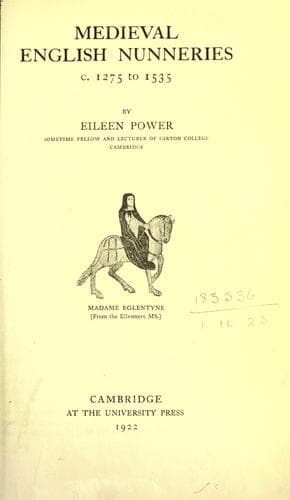
Medieval English Nunneries c. 1275 to 1535Power, Eileen
History
Medieval English Nunneries c. 1275 to 1535
Power, Eileen
Convents -- England; Monastic and religious life of women -- History
Other nuns gave similar evidence and all complained of her favouritism for
two young nuns, whom she called her disciples. Here, as at St Michael's
Stamford, the autocratic behaviour of the nun who was in charge of the
temporalities had aroused the resentment of her sisters and the whole
convent was evidently seething with quarrels[246]. The Prioress of
Ankerwyke, Clemence Medforde, was equally unpopular with her nuns. The
ringleader against her was a certain Dame Margery Kirkby, who poured out a
flood of complaints when Alnwick came to the house. The chief charge
against her was that of financial mismanagement. She was obliged to admit
that she received, paid and administered everything without consulting the
convent, keeping the common seal in her own custody all the year round and
never rendering account. She was also said to have allowed the sheepfold,
dairy and granary to be burned down owing to her carelessness, one result
of which was that all the grain had to stand in the church. She had
alienated the plate and psalters of the house, having lent three of the
latter and pawned a chalice; another chalice and a thurible had been
broken up to make a drinking cup, but, as she had been unable to pay the
sum demanded, the pieces remained in the hands of a monk, who had
undertaken to get the work done. She was charged with having alienated
timber in large quantities and with having cut down trees at the wrong
time of year, so that no new wood grew again; but she denied this
accusation. Another charge made against her by Margery Kirkby, that of
wearing jewels and rich clothes, has already been described; she admitted
it and the fault was the more grave in that she omitted to provide
suitable clothes for the nuns, who went about in rags. It was also
complained that she behaved with undue severity to her sisters; she made
difficulties about giving them licence to see their friends; and she had a
most trying habit of coming late to the services, and then making the nuns
begin all over again. It is obvious that she was greatly disliked by the
convent, perhaps because she was a stranger in their midst, having been
imported from Bromhale to be Prioress; she evidently sought relief from
the black looks of her sisters by visiting her old home, for she was away
at a wedding in Bromhale when the farm buildings caught fire, and one of
the missing psalters had been lent to the prioress of that place. Her
_regime_ at Ankerwyke had been fraught with ill results to the convent,
for no less than six nuns had (without her knowledge, so she said) gone
into apostasy; perhaps to escape from her too rigorous sway. Nevertheless
one cannot help feeling that Margery Kirkby may have been a difficult
person to live with; the Prioress complained that the nuns were often
very easily moved against her and that Dame Margery had called her a thief
to her face; and though it may have been conducive to economy that the
Public-domain text, read in full here on John Shaqi.
Reviews
Reviews
No reviews yet
Be the first to share your thoughts on this work.
Elsewhere in the archive
Join the Discussion
Join the discussion
Sign in to leave a comment or review.
Sign InorCreate an account