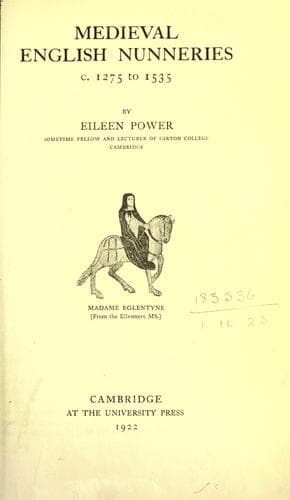
Medieval English Nunneries c. 1275 to 1535Power, Eileen
History
Medieval English Nunneries c. 1275 to 1535
Power, Eileen
Convents -- England; Monastic and religious life of women -- History
Nor was she less prudent in ruling secular business: "she also so
conducted herself with regard to exterior affairs," says the admiring
chronicler, "that she seemed to have the spirit of a man rather than of a
woman." She levelled the court of the abbey manor and built a new hall,
and round the walled court "she made gardens and vineyards and shrubberies
in places that were formerly useless and barren and which now became both
serviceable and pleasant"; she repaired the manor-houses at Tufton and at
Middleton; when the bell tower of the dorter fell down, she built a new
one "of commanding height and of exquisite workmanship"; and one of the
last acts of her life was to take down the unsteady old presbytery and to
lay with her own hands, "having invoked the grace of the Holy Spirit, with
prayers and tears," the foundation stone of a new building, which she
lived to see completed:
These and other innumerable works our good superior Euphemia performed
for the advantage of the house, but she was none the less zealous in
works of charity, gladly and freely exercising hospitality, so that
she and her daughters might find favour with One Whom Lot and Abraham
and others have pleased by the grace of hospitality. Moreover, because
she greatly loved to honour duly the House of God and the place where
His glory dwells, she adorned the church with crosses, reliquaries,
precious stones, vestments and books.
Finally, she "who had devoted herself when amongst us to the service of
His house and the habitation of His glory, found the due reward for her
merits with our Lord Jesus Christ," and died amid the blessings of her
sisters.
Less famous is the name of another mighty builder, who ruled, some two
centuries later, the little Augustinian nunnery of Crabhouse in
Norfolk[260]. Joan Wiggenhall was (as has already been pointed out) a lady
of good family and had influential friends; she was installed as Prioress
in 1420, and began to build at once. In her first year she demolished a
tumble-down old barn and caused it to be remade; this cost L45. 9_s._
6_d._, irrespective of the timber cut upon the estate and of the tiles
from the old barn, but the friends of the house helped and Sir John
Ingoldesthorpe gave L20 "to his dyinge," and the Archdeacon of Lincoln 10
marks. Cheered by this, the Prioress continued her operations; in her
second year she persuaded the Prior of Shouldham to co-operate with her
in roofing the chancel of Wiggenhall St Peter's, towards which she paid 20
marks, and she also made the north end of her own chamber for 10 marks,
and in her third year she walled the chancel of St Peter's and completed
the south end of her chamber. Then she began the great work of her life,
the church of the nunnery itself, and for three years this was the chief
topic of conversation in all the villages round, and the favourite charity
of all her neighbours:
Public-domain text, read in full here on John Shaqi.
Reviews
Reviews
No reviews yet
Be the first to share your thoughts on this work.
Elsewhere in the archive
Join the Discussion
Join the discussion
Sign in to leave a comment or review.
Sign InorCreate an account