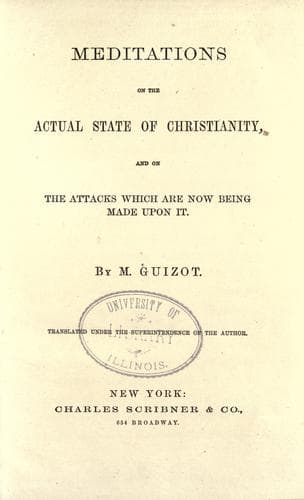
Meditations on the Actual State of Christianity, and on the Attacks Which Are Now Being Made Upon It.Guizot, François
Religion
Meditations on the Actual State of Christianity, and on the Attacks Which Are Now Being Made Upon It.
Guizot, François
Christianity; Philosophy and religion; Religious thought -- 19th century
"I demand nothing better as far as I am concerned; but I cannot
refrain from asking, not without anxiety, whether Christian
Rationalism is really a religion. What remains in the crucible
after the operation just detailed? Is the residue really the
essence of the positive dogmas, or is it but a _caput
mortuum?_ When Christianity is rendered translucent to man's
mind, conformable to man's reason and man's moral appreciation
of things, does it still possess any great virtue? Does it not
very much resemble Deism, and is it not equally lean and
sterile? Does not the potent influence of religious belief
reside in its dogmatic formulas and marvelous legends just as
much as in anything more essentially religious that it
possesses?
{259}
Is there not even somewhat of superstition in genuine piety,
and is it possible for piety to dispense with that popular
system of metaphysics, that attractive mythology, which men
strive to eliminate from it? Do not the elements which you
pretend to abstract from religion constitute the alloy, without
which the precious metal becomes unsuitable for the rough
usages of life? In short, when criticism shall have succeeded
in overthrowing the supernatural as useless, and dogmas as
irrational; when the religious sentiment on the one side, and a
scrupulous reason on the other, shall have penetrated man's
belief, assimilated and transformed it; when no other authority
shall remain standing, save that of the personal conscience of
each individual; when, in a word, man having torn every vail
and penetrated every mystery, shall behold that God face to
face to whom he aspires, will it not be discovered that that
God is, after all, nothing else than man himself, the
conscience and the reason of humanity personified? Will not
religion, in the very attempt to become more religious, have
ceased to exist?"
{260}
Such, according to the views of its most eminent representatives,
are the potent influences and the final results of Rationalism.
After having confusedly attributed to it all the progress of
man's thought and of man's civilization, Mr. Lecky expresses the
apprehension that he has lowered the nature of man, by depriving
him (these are his very words) "of our noblest quality, of the
divine spark, the principle in us of everything that is heroic,"
the complete and pure devotedness of Christian faith. M. Scherer
asks himself sadly if in rejecting all dogma and all positive
revelation, in obliging religious sentiment to be self-sufficing,
and to feed itself with its own and single virtue, rational
criticism does not inflict a deadly blow upon religion itself;
and M. Sainte-Beuve, in the same perplexity, contents himself
with saying, as resignedly, though more coldly, "The heart has
its reasons, which the reason comprehends not."
{261}
Public-domain text, read in full here on John Shaqi.
Reviews
Reviews
No reviews yet
Be the first to share your thoughts on this work.
Elsewhere in the archive
Join the Discussion
Join the discussion
Sign in to leave a comment or review.
Sign InorCreate an account