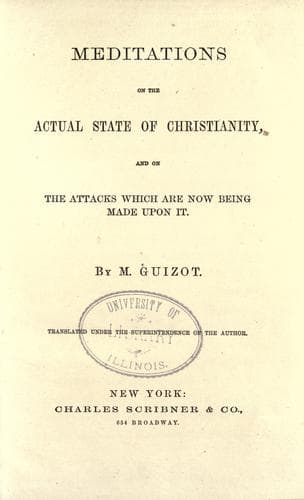
Meditations on the Actual State of Christianity, and on the Attacks Which Are Now Being Made Upon It.Guizot, François
Religion
Meditations on the Actual State of Christianity, and on the Attacks Which Are Now Being Made Upon It.
Guizot, François
Christianity; Philosophy and religion; Religious thought -- 19th century
The instincts, the sentiments, of humanity are certainly not
sufficient reasons for scientific conviction, nor conclusive
proofs in support of any particular system whatever. The
instinctive belief of the human race in one or more supernatural
forces is no demonstration of the reality of the supernatural;
and the aspirings of man's soul for a life beyond this
terrestrial one does not rationally prove the soul's immortality.
Error may occur in human instincts or sentiments just as much as
in human ideas. But when these instincts and these sentiments are
universal, permanent, indestructible, encountered in all ages and
in all countries--when they resist and survive all attacks, all
doubts of reason or science--they are, beyond all question,
considerable facts, and facts which the human understanding
cannot but recognize and respect. If these instincts and
sentiments do not solve the problems which trouble man's
understanding, at least they demand imperiously some solution; if
they throw no light upon his road to science, they oblige him to
see that that road has its mysteries.
{264}
Rationalism mutilates humanity when it ignores such facts,
regarding them as vain illusions because it cannot explain them;
and when, after this mutilation, it assigns the entire empire to
a single portion of the human nature, to a single faculty, called
by it reason, as if reason constituted the entire man,
Rationalism does in the intellectual world what it would be doing
in the physical world did it deny the reality of night because it
only sees the day clearly.
Rationalism is the more wrong in thus discarding facts which it
does not explain, that in its proper domain similar facts occur,
and that its science of reason arrives also finally at mysteries.
I mentioned it before, as a truth acquired to philosophy, that
there exist in the human mind certain universal and necessary
principles, neither furnished to the mind by impressions derived
from the external world, nor created by the mind itself; and that
those principles are inherent in the nature of the mind, and come
to it from another source than that of sensation, or any
discovery of man's own thought.
{265}
We have here a psychological fact which, after the profound
studies of the spiritualistic school from the time of Plato down
to M. Cousin, Rationalism is obliged to admit. To what does this
fact tend, and what is its logical consequence? What but God,
creation, revelation, and the relations of God with man? Will
Rationalism give any better explanation of these divine laws of
the human mind than it has given of the instincts and of the
sentiments of the human heart? or will it ignore the one result
as it has ignored the other?
Public-domain text, read in full here on John Shaqi.
Reviews
Reviews
No reviews yet
Be the first to share your thoughts on this work.
Elsewhere in the archive
Join the Discussion
Join the discussion
Sign in to leave a comment or review.
Sign InorCreate an account