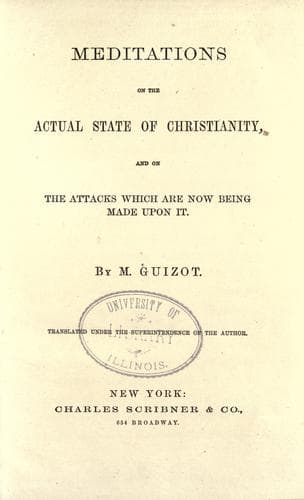
Meditations on the Actual State of Christianity, and on the Attacks Which Are Now Being Made Upon It.Guizot, François
Religion
Meditations on the Actual State of Christianity, and on the Attacks Which Are Now Being Made Upon It.
Guizot, François
Christianity; Philosophy and religion; Religious thought -- 19th century
Many will be tempted to demand how a man so little master of
himself, and whose mind was under so little government, could
ever have succeeded in producing a doctrine so considerable, and
in exercising such real influence upon the philosophical world.
The fact is nevertheless beyond question. Whether the cause is to
be referred to the merit of M. Comte and of his doctrine, or to
the state of men's minds at the time, it is certain that not only
in France but in Europe, and particularly in England, numerous
and honorable disciples came over to his ideas, and that
Positivism became a school wanting neither in sincerity nor
credit. When such men as M. Littré, at Paris, and Mr. J. Stuart
Mill, in London, declare themselves his adherents, the doctrine
has claims to a serious examination.
{271}
M. Auguste Comte lived constantly, as far as he was individually
concerned, under the empire of a fixed idea, which occasioned him
many a painful disappointment; and he lived, as far as his system
was concerned, under the empire of a false idea, which associated
with views just in themselves and sometimes grand, one pervading
and permanent error.
His fixed personal idea consisted in his thinking himself called
to regenerate human science and human society by the single
virtue of his doctrine. Besides their share in the
presumptuousness which is the common character of mankind, minds
that are inventive and fond of systematizing are particularly
prone to extend beyond their legitimate bearings--nay, beyond all
bounds--the pretensions and the hopes which their ideas suggest.
M. Auguste Comte was one of the most striking instances, as well
as one of the most honest victims, of this intellectual
intoxication--the noblest although not the least fantastic form
of human pride.
{272}
The Christian religion has its apostles and it has its
missionaries, speaking in the name of a Master other than
themselves, and preaching a faith they did not themselves
originate. M. Auguste Comte was his own proper apostle--the
inventor and missionary of his own proper faith. Of profound
convictions, with no selfish, worldly views, he aspired to the
entire empire of the intellect, believing both the interests of
social order and the honor of the human mind involved in the
triumph of his doctrine; he ardently desired not only its
propagation, but its organization as a permanent and potent
institution, to insure and perpetuate his triumph. The real and
practical government of nations, according to him, was only, as
it ought to be only, a sort of stewardship, charged with the duty
of realizing and carrying into effect the ideas of thinking men.
"The systematic separation of the two elementary forces, the
Spiritual and the Temporal," so he wrote to Mr. J. Stuart Mill,
"constitutes certainly the principal condition for a
_denouement_ of the actual situation.
{273}
I admit that the special requirements of a situation where those
Public-domain text, read in full here on John Shaqi.
Reviews
Reviews
No reviews yet
Be the first to share your thoughts on this work.
Elsewhere in the archive
Join the Discussion
Join the discussion
Sign in to leave a comment or review.
Sign InorCreate an account