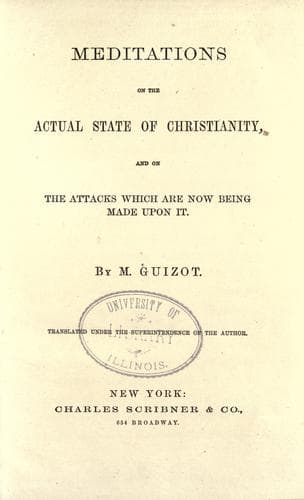
Meditations on the Actual State of Christianity, and on the Attacks Which Are Now Being Made Upon It.Guizot, François
Religion
Meditations on the Actual State of Christianity, and on the Attacks Which Are Now Being Made Upon It.
Guizot, François
Christianity; Philosophy and religion; Religious thought -- 19th century
One can scarcely refrain from a smile when he contemplates these
dreams reduced to the form of system, ignoring every sentiment of
reality, and expounded with the confidence of fanaticism in the
name of a science called Positive. Here it is that we find the
fixed and dominant idea that pervaded and compromised the whole
life of M. Auguste Comte. Whoever did not accept his doctrine and
his system, was for him either a retrogradist full of prejudice,
or an ignoramus without scientific education, or an interested
and jealous enemy. Whoever, on the other hand, lent himself to
his views on any point, or for any time, however short, became in
the eyes of M. Comte his conquest and his property, his
philosophical serf, as it were, bound to his master by the tenure
of duty, and the render of services from which he could never
hope to enfranchise himself, without the risk of being treated
upon the instant as a deserter or a rebel, and of seeing at once
broken the closest and most approved bonds of intimacy and
friendship.
{276}
He had so entire a confidence in his own intellectual
superiority, and in the rights which it conferred, that he
expressed it sometimes with a _näiveté_ amounting almost to
idolatry. One day, believing that he had won over to his ideas M.
Armand Marrast, then the editor of the _National_, he wrote
thus to his wife: "Marrast no longer feels any repugnance in
admitting the indispensable fact of my intellectual superiority;
he is in this respect, in my opinion, especially influenced by
Mill, whom he holds, and with reason, in high account. To speak
plainly and in general terms, I believe that, at the point at
which I have now arrived, I have no occasion to do more than to
continue to exist; the kind of preponderance which I covet
cannot, henceforth, fail to devolve upon me." [Footnote 46]
[Footnote 46: Letter of the 3d December, 1842: "Auguste Comte
et la philosophic positive;" p. 324.]
{277}
Shortly after the date of this letter, M. Comte was separated
from his wife and embroiled with Mr. Mill himself, who had not,
as the former fancied, fulfilled toward him all the duties of an
accepted and loyal disciple.
I pass from the fixed idea of the man to the false idea of his
system; it appears over and over again at each step in the "Cours
de philosophie positive" of M. Auguste Comte, [Footnote 47] and
in the imposing biography consecrated to his memory by his most
accomplished disciple, M. Littré. [Footnote 48]
[Footnote 47: Six volumes 8vo., published in the interval
from 1830 to 1842 inclusive.]
[Footnote 48: Auguste Comte et la philosophic positive. 8vo.
1863.]
I extract from different parts of these volumes the passages in
which the fundamental doctrine is most clearly expressed:
"Positive philosophy is the whole body of human knowledge.
Human knowledge is the result of the study of the forces
belonging to matter, and of the conditions or laws governing
those forces." [Footnote 49]
Public-domain text, read in full here on John Shaqi.
Reviews
Reviews
No reviews yet
Be the first to share your thoughts on this work.
Elsewhere in the archive
Join the Discussion
Join the discussion
Sign in to leave a comment or review.
Sign InorCreate an account