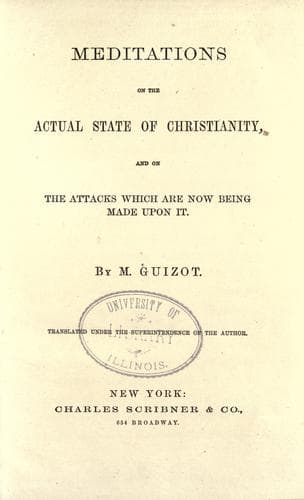
Meditations on the Actual State of Christianity, and on the Attacks Which Are Now Being Made Upon It.Guizot, François
Religion
Meditations on the Actual State of Christianity, and on the Attacks Which Are Now Being Made Upon It.
Guizot, François
Christianity; Philosophy and religion; Religious thought -- 19th century
ascendancy; an ascendancy, in other respects, far more likely
to be furthered than retarded by such coordination of its
adversaries, for this will tend to give at last to the
struggles of philosophy a decisive character; but the
Positivists will alone succeed in prevailing (at least as far
as speculative doctrines are concerned) over the coalition of
all the philosophical forces of the ancient school, whether
metaphysical or theological." [Footnote 54]
[Footnote 54: Auguste Comte et la phil. pos., by M. Littré,
pp. 370, 434. ]
{281}
M. Comte had even more aversion for Metaphysics than for
Theology. He took particular offense at the contemporary
spiritualistic school, and the scientific psychology of MM.
Royer, Collard, Maine de Biran, Cousin, and Jouffroy.
"In no view," said he, "is there any room for this illusory
psychology; this final transformation of a theology, which men
strive, nowadays, so idly to reanimate; for--without troubling
itself either with the physiological study of our intellectual
organs, or with the observation of those rational processes,
which in effect direct our different scientific
researches--Psychology pretends to arrive at the discovery of
the fundamental laws of the human mind by contemplating that
very mind--that is to say, by making complete abstraction both
of causes and of effects." [Footnote 55]
[Footnote 55: Cours de philosophic positive, by M. Auguste
Comte, vol. i, p. 34.]
{282}
Even while absolutely rejecting Theology, M. Comte treated it
with more esteem than Metaphysics.
"We are," he said, "too disposed, nowadays, to ignore the
immense benefits due to religious influence. The positive
philosophy, however paradoxical it may be to claim for it such
a peculiarity, is virtually the only philosophy capable of
worthily appreciating all the participation of the spirit of
religion in the whole grand development of humanity. Is it not
directly evident that, as by an invincible organic necessity,
moral efforts have almost always to combat to some degree or
other the most energetic impulses of our nature; the
theological spirit was imperatively called upon to furnish to
social discipline that general basis which was quite
indispensable at a time when human foresight, whether of men in
masses or of men as individuals, was certainly far too limited
to offer any sufficient _point d'appui_ to influences
purely rational?"
{283}
... "When the positive philosophy shall have acquired that
character of universality which it is still without, it will be
capable of replacing entirely, with all its native superiority,
that theological philosophy and that metaphysical philosophy of
which this universality is in these days the sole real
peculiarity, and which, deprived of this motive for preference,
will have for our successors nothing but an historical
existence." [Footnote 56]
Public-domain text, read in full here on John Shaqi.
Reviews
Reviews
No reviews yet
Be the first to share your thoughts on this work.
Elsewhere in the archive
Join the Discussion
Join the discussion
Sign in to leave a comment or review.
Sign InorCreate an account