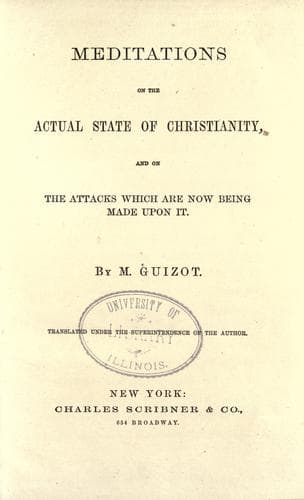
Meditations on the Actual State of Christianity, and on the Attacks Which Are Now Being Made Upon It.Guizot, François
Religion
Meditations on the Actual State of Christianity, and on the Attacks Which Are Now Being Made Upon It.
Guizot, François
Christianity; Philosophy and religion; Religious thought -- 19th century
He appeals to two arguments--the one metaphysical, the other
historical; the one derived from the mind of man itself, the
other from the history of humanity.
I cannot here follow M. Comte in his long and complex explanation
of the two orders of proofs to which he appeals in support of his
system; what I shall say will, I think, suffice to demonstrate
that neither can stand any serious examination.
As a metaphysician--for metaphysician he must permit himself to
be called, since he makes use of metaphysics, whatever his
antipathy for philosophers who bear that name;--as
metaphysician, I repeat, M. Auguste Comte belongs to the
sensualistic school, He thinks with Locke and Condillac, that man
deduces all his ideas and all his knowledge from impressions
received by him from the outer world, and from the reflections
which he makes upon those impressions.
{287}
He takes, therefore, as his starting point, the maxim of that
school which proclaims that "there is nothing in the intelligence
which has not first been in the sense." Nevertheless, whether by
an act of proper and remarkable sagacity, or struck by the reply
of Leibnitz, "unless the intelligence itself," he admits that
sensation does not account for all that passes and develops
itself in the mind of the observer of the external world. "If,"
he says, "on the one side every positive theory must necessarily
be founded upon observation, it is, on the other side, equally
plain that to apply itself to the task of observation, our mind
has need of some 'theory.' If, in contemplating the phenomena, we
do not immediately attach them to certain principles, not only
would it be impossible for us to combine these isolated
observations, so as to draw any fruit therefrom; but we should be
entirely incapable of retaining them, and in most cases the facts
would remain before our eyes unnoticed.
{288}
The need at all times of some 'theory' whereby to associate
facts, combined with the evident impossibility of the human mind
at its origin forming 'theories' out of observations, is a fact
which it is impossible to ignore." [Footnote 58]
[Footnote 58: Cours de philosophic positive, par M. Auguste
Comte, vol. i. p. 8.]
This fact, thus proved by M. Comte himself; this necessary part
of the human mind, indispensable to enable it to acquire
knowledge of the external world; this "theory," anterior to all
observation, which man requires for the purpose himself of
observing, what are they else than those universal and necessary
principles proclaimed by the spiritualistic school, and to which
I recently referred?--principles inherent in the human mind,
which it applies as from its own stores in taking cognizance of
the external world, and by virtue of which, just as one mounts a
river up to its source, man mounts and mounts up to God, and up
to the relations of man with God.
{289}
Public-domain text, read in full here on John Shaqi.
Reviews
Reviews
No reviews yet
Be the first to share your thoughts on this work.
Elsewhere in the archive
Join the Discussion
Join the discussion
Sign in to leave a comment or review.
Sign InorCreate an account