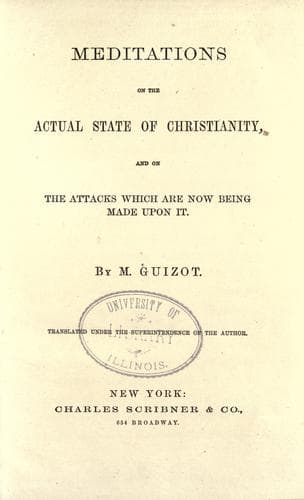
Meditations on the Actual State of Christianity, and on the Attacks Which Are Now Being Made Upon It.Guizot, François
Religion
Meditations on the Actual State of Christianity, and on the Attacks Which Are Now Being Made Upon It.
Guizot, François
Christianity; Philosophy and religion; Religious thought -- 19th century
The progress of Materialism is evident; progress in the learned
world and in the unlearned world, in the name of the scientific
studies and of popular tendencies. A contemporary spiritualistic
philosopher, as distinguished by intellectual probity as by the
independence and the moderation of his opinions, of whom the Duke
de Broglie, on learning his death, exclaimed, "We have lost a
sage"--M. Damiron I mean--published eight years ago his
"Mémoires pour servir à l'histoire de la philosophie au 18
siècle;" he had read it in successive parts to the _Académie
des Sciences Morales et Politiques_. He said in his preface,
"Men are disposed a second time to have Sensualism; they insist
upon something that they may oppose to and substitute for pure
and simple Spiritualism: be it so; but then let them at least
well understand what it is that they are asking for.
{332}
It is not merely Locke, the moderate chief of the school, nor is
it d'Alembert, nor Saint-Lambert, nor even Helvetius; these keep
themselves relatively within bounds: it is Diderot who has so
little moderation, it is d'Holbach, it is Naigeon, it is Lalande,
and de la Mettrie; it is a whole order of minds, not very
eminent, but very decided and very consistent and logical in
their materialism; materialists in all and for all, from the soul
up to God--not forgetting, be it remembered, liberty, duty, a
future life, etc. ... These men, with their heads in the air and
their masks in their hand, with a confidence in themselves and a
faith almost confounding itself with religion, profess openly as
truth, fatalism, egotism, and atheism. This is what men want, and
what, if they wish to be logical, men must want, when, closely or
remotely, they adhere to a philosophy that reduces everything to
sensation, and that which is the object of sensation. Let there
then be no illusion upon this subject; all the principles of
morals and of religion are at stake. Sensualism _is_ what it
is, and _can_ be nothing else. It was made a complete system
in the eighteenth century; nothing remains in it that can be
either made or remade; and if men recur to it in our days, the
mechanism and the form may be altered--for these are
variable--but not the essential substance, for that is _not_
so.
{333}
There are not two manners of being consequent any more in this
system than in any other; however the attempt may be made, men
can never by any reproduction render it what it is not, and what
its nature prevents it from ever being; so we must take it or we
must leave it alone; we cannot change its principles." [Footnote
71]
[Footnote 71: Memoires pour servir à l'histoire de la
philosophie au 18 siècle, by Ph. Damiron, member of the
Institute; vol. i, p. xiv. 1858.]
Public-domain text, read in full here on John Shaqi.
Reviews
Reviews
No reviews yet
Be the first to share your thoughts on this work.
Elsewhere in the archive
Join the Discussion
Join the discussion
Sign in to leave a comment or review.
Sign InorCreate an account