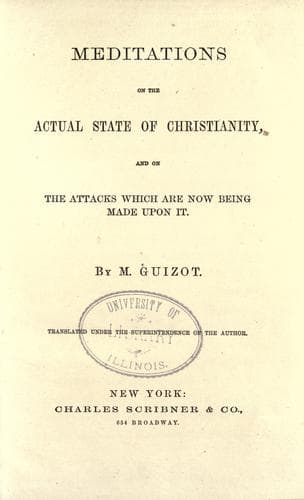
Meditations on the Actual State of Christianity, and on the Attacks Which Are Now Being Made Upon It.Guizot, François
Religion
Meditations on the Actual State of Christianity, and on the Attacks Which Are Now Being Made Upon It.
Guizot, François
Christianity; Philosophy and religion; Religious thought -- 19th century
The hypothesis of Materialism has but a single merit; it is more
consistent than those of the other systems. But even to this
merit Materialism loses its title whenever it shrinks from
pushing its principles boldly to their consequences, whether
philosophical or practical: that is to say, whenever it shrinks
from denying man's liberty, a moral law, the necessary principles
of the human mind--whenever, in short, it shrinks from
proclaiming its ultimate results, which are, as M. Damiron puts
them, Fatalism, Egotism, Atheism. Philosophers are right in
seeking for truth and in respecting truth for itself and at every
risk; but there are some consequences which are the clearest
evidence of a vice in principle; and this vice, in Materialism,
is the blind forgetfulness of the best proved facts and the most
essential elements of human nature.
---------------------------------------
{350}
Seventh Meditation.
Skepticism.
There are two kinds of Skepticism, experimental Skepticism and
systematic Skepticism. Experimental Skepticism is the result of
the incertitude which arises in men's minds from the spectacle of
the infinite variety, discordance, and mobility of human
opinions. Systematic Skepticism, on the other hand, challenges
the power itself of the human understanding, and declares it
incapable of knowing things in their essence--reality in itself.
The one is doubt applied in practice; the other is doubt affirmed
as a principle.
{351}
In an essay on Skepticism, written in 1830, M. Jouffroy treated
experimental and practical skepticism with great contempt: this
skepticism "founds itself," says he, "only upon the apparent
contradictions of human judgment. To prove that there is a
contradiction either between the results at which each faculty of
the mind when taken separately arrives, or between the final
results attained by different faculties, as by the sense and by
the reason; to establish that there is a contradiction of a like
nature between the opinions received by different men or by
different nations, or between those opinions themselves, which,
at different epochs, have variously for a time contented
humanity; then to conclude from all this that the human
intelligence regards in turn as true things which are
contradictory, and that consequently there is for that
intelligence no truth at all: such is all the mechanism in which
this second-rate skepticism consists which has fascinated, and
still continues to fascinate, whole hosts of little minds. Long
ago this skepticism was refuted, and at all its points; long ago
the unity of human truth was demonstrated, after having been
admitted _à priori_ in all ages by their leading minds.
{352}
This kind of skepticism is a theme upon which men will long
continue to dilate; the darling subject for wits, it merits not
to arrest the attention of philosophers."
Public-domain text, read in full here on John Shaqi.
Reviews
Reviews
No reviews yet
Be the first to share your thoughts on this work.
Elsewhere in the archive
Join the Discussion
Join the discussion
Sign in to leave a comment or review.
Sign InorCreate an account