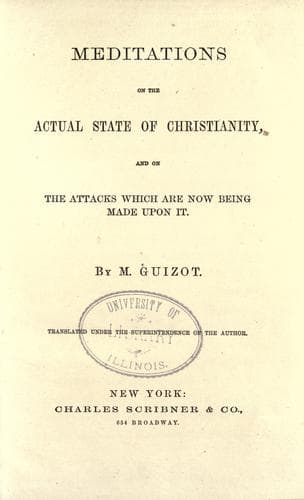
Meditations on the Actual State of Christianity, and on the Attacks Which Are Now Being Made Upon It.Guizot, François
Religion
Meditations on the Actual State of Christianity, and on the Attacks Which Are Now Being Made Upon It.
Guizot, François
Christianity; Philosophy and religion; Religious thought -- 19th century
I have read, and read over again, with scrupulous attention, the
two principal philosophical treatises of M. Vacherot, _La
Métaphysique et la Science ou Principes de Philosophie
Positive,_ [Footnote 79] and the _Essais de Philosophie
Critique_. [Footnote 80]
[Footnote 79: Second edition, three vols. 12mo., 1863.]
[Footnote 80: One vol. 8vo., 1864.]
M. Vacherot does not desire to be, nor is he really, in his
conscience and in his own eyes, an advocate either of
Materialism, or Positivism, or Pantheism, or Atheism, or
Skepticism.
{381}
He analyzes and he refutes successively these different systems,
as conceived and expounded by their most distinguished
representatives; he defends himself, and with warmth, from the
charge of adhering to them: "a man," he says, "is not an Atheist,
a Materialist, a Pantheist, an Idealist, because he does not
believe in God, soul, mind, matter, world--in all these
metaphysical words taken in a given acceptation. The true
_Atheist_, if such a one exists, is he whose mind is grossly
empirical, and wanting in the sense of what is intelligible,
ideal, and divine. The true _Pantheist_ is he who identifies
truth and reality, God and the world, whether, like Spinoza and
Goethe, he deifies the world, or like the Stoics, he materializes
God. The true _Materialist_ is he who degrades man to the
beast, either by denying him his superior and really human
faculties, or by deriving these from animal faculties. The true
_Idealist_, like Berkeley, is he who rejects all external
reality as an illusion, whatever the conception of that reality;
whether it be as a thing made up of forces and of laws, or as
consisting of extended matter. ... All these words require to be
defined and explained, or they necessarily occasion mysteries,
contradictions, and absurdities. In their vague complexities they
do not express ideas of sufficient simplicity, nor do they answer
to ideas sufficiently precise for science to adopt them
unreservedly and without distinction. ...
{382}
A chosen few exist whose sympathy is dear to me; I remain
profoundly attached to all the truths which they, with reason,
regard as constituting the strength, life, and honor of
philosophy. I remain, like them, a Spiritualist, an Idealist, a
Theist, although with other methods, another language, and also,
beyond a doubt, with notable reservations." [Footnote 81]
[Footnote 81: La Métaphysique et la science; in the
Introduction and the Preface, vol. i., pp. xvi, xxxiv.]
Public-domain text, read in full here on John Shaqi.
Reviews
Reviews
No reviews yet
Be the first to share your thoughts on this work.
Elsewhere in the archive
Join the Discussion
Join the discussion
Sign in to leave a comment or review.
Sign InorCreate an account