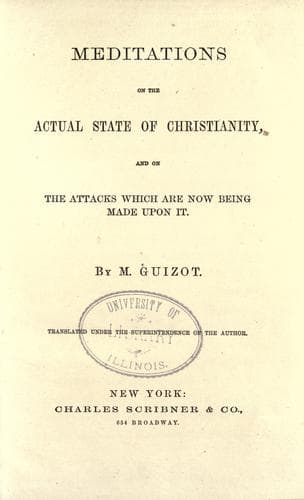
Meditations on the Actual State of Christianity, and on the Attacks Which Are Now Being Made Upon It.Guizot, François
Religion
Meditations on the Actual State of Christianity, and on the Attacks Which Are Now Being Made Upon It.
Guizot, François
Christianity; Philosophy and religion; Religious thought -- 19th century
They were at first and especially occupied with the real
resuscitation of that Christian religion, now returning to French
society, to its rank there and to its mission, but returning as
exiles return--ill provided, disorganized, and to a home that
seems no home.
{72}
To render back to France, now Catholic, churches for its worship,
priests for its churches, seminaries to form its priests, pupils
to people those seminaries; to assure also to the edifice thus
rising from its ruins the time for its proper establishment and
consolidation--such, under the first empire, was the dominant
thought, almost the exclusive thought, of the Episcopacy, of the
clergy instituted by the Concordat. A work great and difficult,
for which neither materials nor workmen were at hand, and which
required for its accomplishment strong support and a long period
of repose. The clergy of this epoch have been justly reproached
with their uniform obsequiousness to the Emperor Napoleon. No
doubt it was a shameful spectacle, in 1811, which those docile
bishops afforded, when they assembled in council and were never
weary of lavishing caresses upon the despot who had not only
stripped the chief of their Church, Pius VII., of his dominions,
but was then detaining him a prisoner at Savona, denying his
natural counselors, the cardinals, all access to him, refusing
him even a secretary to write his letters, and charging an
officer of the gendarmerie to watch by day and by night all his
movements.
{73}
Only a single fact explains and somewhat excuses the
pusillanimity of the clergy when confronted with this tyranny:
these bishops had seen Christianity proscribed, its churches
closed, profaned, demolished, its priests hunted and massacred,
their flocks left without any worship, any guide, any
consolation. The chance of the recurrence of such events filled
them with horror. Who could affirm that there was no such chance,
and that the reality of the eve was not the possibility of the
morrow? With such causes of apprehension a good priest might feel
his conscience profoundly troubled; and a timid priest might
regard his weakness as justified. What sacrifices were not
permissible, nay, even imperative, to prevent such disasters?
{74}
Still, the violent measures of Napoleon did not fail to
encounter, sometimes rebukes, and occasionally resistance, on the
part of the clergy; it was not only that some prelates [Footnote
9] in the council, with more courage than moderation, censured
his conduct toward the Pope: the council itself--forgetting at
last, in its anxiety to vindicate the honor of the whole body,
its long habit of obsequiousness--voted an address to the
Emperor, an act of independence which occasioned its abrupt
dissolution.
[Footnote 9: Among others M. d'Avian, Archbishop of Bordeaux,
M. de Boulogne, Bishop of Troyes, and M. de Broglie, Bishop
of Gaud.]
Public-domain text, read in full here on John Shaqi.
Reviews
Reviews
No reviews yet
Be the first to share your thoughts on this work.
Join the Discussion
Join the discussion
Sign in to leave a comment or review.
Sign InorCreate an account