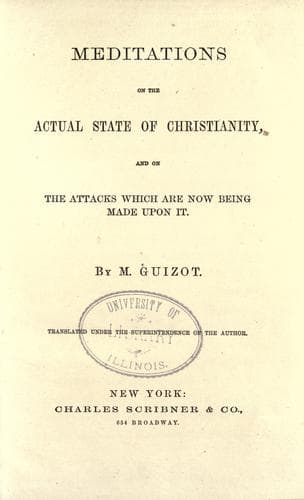
Meditations on the Actual State of Christianity, and on the Attacks Which Are Now Being Made Upon It.Guizot, François
Religion
Meditations on the Actual State of Christianity, and on the Attacks Which Are Now Being Made Upon It.
Guizot, François
Christianity; Philosophy and religion; Religious thought -- 19th century
And of the two ecclesiastics to whose counsels, from just motives
of esteem, Napoleon showed least disinclination to give ear,
one--the Abbé Émery, "Superior General" of the Congregation of
St. Sulpice--had just previously, not long before he died,
openly, yet with dignity, resisted the Emperor; [Footnote 10] the
other, M. Duvoisin, Bishop of Nantes, dictated upon his deathbed
these powerful and affectionate lines: "I supplicate the Emperor
to restore the holy Father to liberty. His captivity troubles the
extreme moments of my life. On several occasions I had the honor
to inform the Emperor of the affliction which this captivity is
causing to the whole of Christendom, and of the inconveniences
which would attend its prolongation. The happiness of his Majesty
himself, I believe, depends upon the return of his Holiness to
Rome."
[Footnote 10: Vie de M. Émery, supérieur général du séminaire
et de la compagnie de Saint-Sulpice, t. ii, pp. 236-346.
Paris: 1862.]
{75}
Idly does Despotism excuse its arbitrary acts, as if they
resulted from the want of foresight or the servility of its
flatterers; for the blindest have their gleams of light, and even
the most timid their intrepid moments, during which they speak
the truth, although they speak it in vain.
Under the Restoration, it was no longer fear, but hope--hope,
ill-founded, too--which misled the French clergy, betrayed them
into the commission of many faults, and checked the progress of
roused Christendom.
{76}
In the then reaction against the Revolution, ecclesiastical
ambition had its part; partisans of the Crown and of Rome--ardent
ones--some through sincere devotion, others from political
calculation, believed it to be necessary and possible to restore
to the Catholic clergy a part at least of the social position and
of the direct authority which they had possessed before 1789.
This was evincing a strange ignorance of the fundamental
character of French society, such as it has been made by its
history and by its great modern Revolution. French society is
essentially and insuperably "laic;" the separation of temporals
from spirituals, and the empire of the laity in public affairs,
are consummated and dominant facts, not to be attacked, or even
menaced, without occasioning throughout the whole framework of
society an irritation and a disquietude, perilous alike for
Church and for State. Nothing in France at the present moment is
more fatal to the influence of religion than the chance, or the
appearance even, of ecclesiastical domination.
{77}
This chance and this appearance were, under the Restoration, the
plague of the Catholic religion and of the French clergy--a
plague the grave consequences of which are the more to be
deplored as it was neither very deep-seated nor very formidable.
It is a fact too little remarked, that the clergy were not then
the principal authors of the faults which subsequently both they
and religion had such cause to rue. No doubt many inadmissible
Public-domain text, read in full here on John Shaqi.
Reviews
Reviews
No reviews yet
Be the first to share your thoughts on this work.
Join the Discussion
Join the discussion
Sign in to leave a comment or review.
Sign InorCreate an account