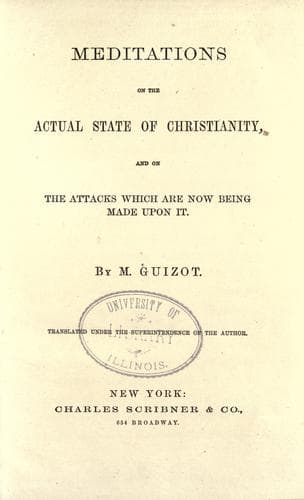
Meditations on the Actual State of Christianity, and on the Attacks Which Are Now Being Made Upon It.Guizot, François
Religion
Meditations on the Actual State of Christianity, and on the Attacks Which Are Now Being Made Upon It.
Guizot, François
Christianity; Philosophy and religion; Religious thought -- 19th century
At all epochs and in all parties some man is always met with in
whom are centered and personified whatever good sense, sound
views, and wise purposes there are in the party to which he
belongs. Such a man under the Restoration and for the lay
Legitimists was M. de Villèle. True to his friends, he
nevertheless knew, or I should rather say he promptly learned in
public life to understand, what France then actually was, and
what qualities, to be successful, her government should possess.
If he had had toward his party and his king as much independence
and firmness in action as he had correct appreciation in thought,
he might perhaps have obtained a more complete and more lasting
success. The clergy on their side also had at this epoch a
faithful representative of whatever religious or political
sagacity existed in the French Church: it is here to the Abbé
Frayssinous, Bishop of Hermopolis, that the honor and the merit
belong. His task was far easier than that of M. de Villèle, for
he was never put to any trial: he had no struggle to sustain; he
remained naturally, or kept himself voluntarily, out of the arena
of events and of parties; but it was in this precisely that he
showed his good sense, and his correct appreciation of the
permanent interests and the real dispositions of the clergy of
his time.
{81}
Neither as theologian, nor as orator, nor as statesman was the
Abbé Frayssinous a man of eminence, or remarkable for power of
intellect; but in the different phases of his career, in his
personal conduct, and in his writings, he had an unerring
instinct of what was just and possible, and showed no common tact
in retiring with dignity from untenable positions, and escaping
from questions that he could not settle. Upon these occasions he
would confine himself to his mission of a priest and moralist of
the Christian religion. From 1803 to 1822 he held, suspended, and
resumed in the Church of St. Sulpice, his "conferences upon
religious subjects;" remarkable not only by a judicious defense
of the great truths of Christianity, but by a continuous,
although somewhat timorous, effort to place the doctrines of the
Church in harmony with the principles of natural justice and of
civil liberty.
{82}
He was not, like the Père Lacordaire or M. de Montalembert, a
Catholic Liberal; he was a priest--moderate and equitable, not
from luke-warmness in his faith, but from respect to legal rights
and human sentiments. Although his "conferences" had not the
success and popularity that distinguished later, in Notre-Dame,
those of the Père Lacordaire, they attracted a numerous auditory,
and exercised material influence in giving to the awakening of
Christianity a wider range and a firmer basis. [Footnote 11]
Public-domain text, read in full here on John Shaqi.
Reviews
Reviews
No reviews yet
Be the first to share your thoughts on this work.
Join the Discussion
Join the discussion
Sign in to leave a comment or review.
Sign InorCreate an account