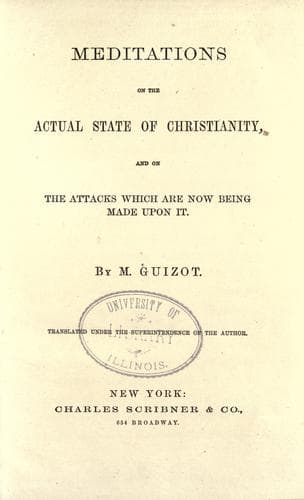
Meditations on the Actual State of Christianity, and on the Attacks Which Are Now Being Made Upon It.Guizot, François
Religion
Meditations on the Actual State of Christianity, and on the Attacks Which Are Now Being Made Upon It.
Guizot, François
Christianity; Philosophy and religion; Religious thought -- 19th century
claims, many unreasonable and offensive requirements, many rash
expectations, proceeded from the ranks of the clergy; but there
was in all this more a suggestion of their past history, or an
unmeaning vanity, than a real and ardent ambition; even the
clergy felt instinctively that political power was not now suited
to them, and that France would no longer accept at their hands as
ministers even a Cardinal Richelieu or a Cardinal Mazarin.
{78}
At first the contra-revolutionary and non-ecclesiastical party in
the Chamber of 1815, and, afterward, the blind fanatical coterie
of the Court of Charles the Tenth, hurried the clergy into their
own vortex, and compromised the cause of religion by making its
ministers instruments of their influence and auxiliaries in their
combats. The ecclesiastics had not the courage to resist; in
spite of their distaste for the new spirit which was abroad, most
of the bishops and of the priesthood, warned by their experience
in the Revolution, would have preferred to remain out of the
sphere of politics, and to confine themselves to the functions of
their religious mission, rather than to be constantly struggling
against popular opinions; so, when any opportunity presented
itself to show their sympathy, they hastened to embrace it. When,
in 1824, the bill of M. de Villèle for the conversion of the
"Rentes" created a great stir among the "Bourgeoisie" of Paris,
it was the Archbishop of Paris, M. de Quélen, who constituted
himself in the Chamber of Peers the principal organ of the
Opposition; and when, in 1828, the movement of public opinion and
of the magistracy against the religions congregations wrested
from the King (Charles the Tenth) the Ordonnances of the 21st
June, the Bishop of Beauvais, M. Feutries, at that time the
Minister of Ecclesiastical Affairs, did not hesitate to
countersign them.
{79}
The members of the priesthood live in close contact with the
people, and cannot long remain in ignorance of the real state of
their opinions, or long persist in holding them lightly. The
French clergy, as a whole, were more resigned to the new state of
society than King Charles the Tenth and his intimate friends; the
false ideas and the unreasonable political pretensions of the
monarch and of the coterie which formed his court, far more than
the religious bigotry of the Church, occasioned the great faults
committed under the Restoration.
{80}
Public-domain text, read in full here on John Shaqi.
Reviews
Reviews
No reviews yet
Be the first to share your thoughts on this work.
Join the Discussion
Join the discussion
Sign in to leave a comment or review.
Sign InorCreate an account