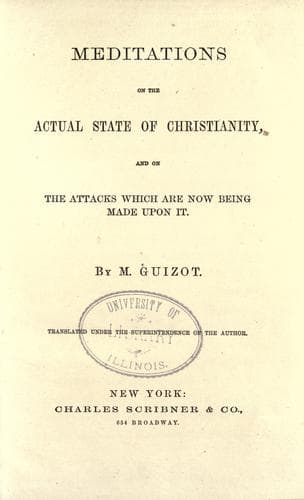
Meditations on the Actual State of Christianity, and on the Attacks Which Are Now Being Made Upon It.Guizot, François
Religion
Meditations on the Actual State of Christianity, and on the Attacks Which Are Now Being Made Upon It.
Guizot, François
Christianity; Philosophy and religion; Religious thought -- 19th century
Veuillot at the commencement of his literary career,
when he accompanied General Bugeaud to the seat of his government
in Algeria. At this epoch he addressed to me two memorials upon
the subject of the moral condition of the colony and of the army.
They struck me by their decided tone, and the straightforwardness
and candor with which he expressed sentiments already
distinguished by devotion. Already he regarded the religion of
his own Church, and of _it_ alone, as the sure basis of
human morality and social order; but he had not yet proclaimed as
his doctrine the deplorable error that Faith enjoins war upon
Liberty. He merited a better understanding of the cause of
Christianity; he merited to be a better advocate of the Church at
Rome than an advocate who, although one of its most devoted
defenders, has yet most injured the cause that he sought to
serve.
{90}
These political revolutions and these domestic dissensions left,
in the period that ensued after 1830, the Catholic Church in a
difficult situation, but in one salutary for it and fruitful of
consequences. The clergy no longer counted on the favor of
Government, but they had at the same time to fear from it neither
violence nor hostility. Left to themselves, they felt the
necessity of independent existence, and saw that they must
replace credit with the authorities by influence with the
country; and this influence they were likely to obtain. If they
did not possess all the privileges which they coveted, they had
enough to enable them every day to conquer additional powers,
supposing them willing and sagacious enough to take the trouble
and employ the right means.
{91}
In my opinion, they did not do at this epoch, in the interest of
religion and of the Church, all that their position permitted, or
all that their mission required at their hands; but temporal or
spiritual governors, layman or priests, who ever did, I do not
say what he ought, but what he could have done? The greater part
of the bishops and of the priests were vacillating and timorous;
the problem before them went beyond their opinions, and the
events beyond their strength; the impetuous Liberalism of M. de
Montalembert and of his friends disquieted them; they saw in him
rather a valiant champion than a representative they could rely
upon. Among those who joined with him in the struggle for the
freedom of instruction, there were some who showed, with
reference to the Government of 1830 and the University, little
fairness or prudence: these injured the cause rather than served
it. Whether from submission to orders from Rome, or from their
natural impulse, the clergy, taken as a whole, showed little
taste for liberty; even while they demanded it, they were rather
inclined to immobility than progress.
{92}
But whatever the fears and hesitations of individuals, when the
general current of ideas and of popular opinions once penetrates
to the classes least disposed to entertain them, it never fails,
Public-domain text, read in full here on John Shaqi.
Reviews
Reviews
No reviews yet
Be the first to share your thoughts on this work.
Elsewhere in the archive
Join the Discussion
Join the discussion
Sign in to leave a comment or review.
Sign InorCreate an account