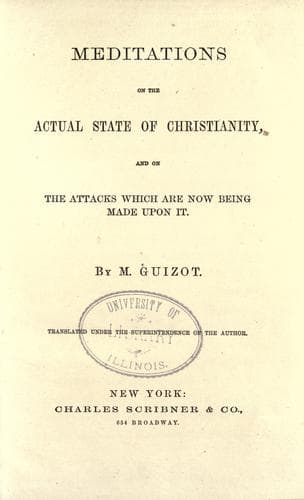
Meditations on the Actual State of Christianity, and on the Attacks Which Are Now Being Made Upon It.Guizot, François
Religion
Meditations on the Actual State of Christianity, and on the Attacks Which Are Now Being Made Upon It.
Guizot, François
Christianity; Philosophy and religion; Religious thought -- 19th century
whether they avow it, or whether they even know it, to swell and
to advance. Around and among the clergy themselves the spirit of
progress and of liberty gained ground, although by insensible
degrees. Here and there individual priests, like the Abbé
Bautain, formerly a student with M. Jouffroy at the École
Normale, and Professor of Philosophy in the Faculty of Letters at
Strasbourg, propagated in the Church the liberal movement,
forming for it in different places new centers of action. The
spirit which had awakened Christianity manifested itself, too, in
our great lay establishments for the higher course of
instruction; not always without check, but still with a success
the more conspicuous the more it was contested.
{93}
In 1846, some disturbances, occasioned by a thoughtless and
puerile intolerance, made by M. Lenormant, at that time my
substitute (suppléant) in the chair of Modern History at the
Faculty of Letters, determine to withdraw from the Sorbonne,
where he had made a courageous avowal of his faith; but M.
Ozanam, the worthy successor to the chair of M. Fauriel,
maintained in the same place the same principles with a more
successful perseverance, and with such a depth of conviction and
such a warmth of emotion that sometimes he carried the feelings
of his auditors away with him, and sometimes commanded respectful
attention even from those most confirmed in their incredulity.
And while the spirit of Christianity was thus manifesting itself
in the free Faculty of Letters, the teaching of the Faculty of
Theology attested, under that same roof, a notable progress in
knowledge and in Liberalism. The Abbé Maret, in his lectures on
the Dogmas of Religion, the Abbé Frère, in his discourses on the
Scriptures; the Abbé Dupanloup and the Abbé Gerbet, in their
lectures on Sacred Eloquence, displayed not only a firm and
active faith, but views upon philosophy, history, and literature,
necessarily implying an acquaintance with the works of human
science, and an appreciation of the rights of liberty.
{94}
Ecclesiastics and laymen, not members of the scientific
establishments of the State, published, under the name of the
"Université Catholique," a series of courses in which philosophy,
history, natural sciences, archaeology, and the arts were
explained and taught in harmony with the dogmas and sentiments of
religious men. And even far from Paris, in several great
episcopal seminaries, classical and theological studies took a
wider range, and attained a scientific value that they had not
for a long time possessed.
Public-domain text, read in full here on John Shaqi.
Reviews
Reviews
No reviews yet
Be the first to share your thoughts on this work.
Elsewhere in the archive
Join the Discussion
Join the discussion
Sign in to leave a comment or review.
Sign InorCreate an account