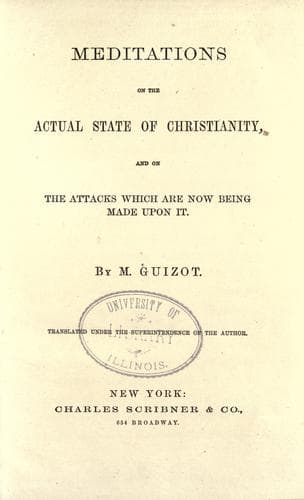
Meditations on the Actual State of Christianity, and on the Attacks Which Are Now Being Made Upon It.Guizot, François
Religion
Meditations on the Actual State of Christianity, and on the Attacks Which Are Now Being Made Upon It.
Guizot, François
Christianity; Philosophy and religion; Religious thought -- 19th century
A Catholic priest, now a bishop, inquiring the origin of the
actual disputes of religion, and their probable issue, expresses
himself as follows:--"Free institutions, freedom of conscience,
political liberty, civil liberty, individual liberty, liberty of
families, of education, and of opinions, equality before the
laws, the equal division of imposts and of public charges, these
are all points upon which we make no difficulty; we accept them
frankly; we appeal to them on solemn occasions of public
discussion; we accept, we invoke the principles and the liberties
proclaimed in 1789; even those who combat those principles and
those liberties admit that liberty of religion and free education
have become acknowledged, self-evident truths (_des verités de
bon sens_)." [Footnote 13]
[Footnote 13: De la Pacification religieuse. By the Abbé
Dupanloup, pp. 263, 294, 306. Paris, 1845.]
{119}
This Catholic, this bishop, is no timorous priest, disposed to
make every sacrifice for the purpose of conciliation. It is the
same priest, who, from the first attack made upon the
constitution of the Catholic Church, has always distinguished
himself by the warmth and ability with which he has defended it.
The Papacy, its rights, its temporal independence and spiritual
sovereignty never had a champion more resolute, more opposed to
weak concessions or fallacious compromises, more constantly
intrepid in the breach than the Bishop of Orleans.
{120}
When the contest was warmest, the Pope (Pius IX.) published his
"Encyclical" of the 8th of December, 1864. Exempt from every
feeling of prejudice and hostility, and having no connection or
relation with the Papacy to make me pause, I feel no hesitation
in saying what I think of this document, at once the occasion and
the pretext for such a stir. In my opinion the error was a grave
one. Regarded as doctrine, the "Encyclical" was dignified and yet
embarrassed, positive and yet evasive; it confounded in the same
sweeping condemnation salutary truths and pernicious errors, the
principles of liberty and the maxims of licentiousness; it made
an effort to maintain, in point of right, the ancient traditions
and pretensions of Rome, without avowing in point of fact that
the ideas and potent influences of modern civilization were the
objects of its declared and unceasing hostility. In a system like
that of the present day--a system of publicity and freedom of
discussion--this manner of proceeding, its inconsistencies, its
reticence, its obscurities, whether arising from instinct or
premeditation, have ceased to be good policy, and in fact serve
no purpose whatever.
{121}
As a measure to meet a particular emergency, the "Encyclical" of
the 8th of December 1864 did not resemble that of Gregory XVI. in
1832; it was not called for by such extravagances as those of the
_Avenir_, or those of the Abbé de la Mennais; no urgent
necessity, no public exigency required that Rome should pronounce
Public-domain text, read in full here on John Shaqi.
Reviews
Reviews
No reviews yet
Be the first to share your thoughts on this work.
Elsewhere in the archive
Join the Discussion
Join the discussion
Sign in to leave a comment or review.
Sign InorCreate an account